9 Things I Learned from Critique Group

I am very fortunate to have a wonderful critique group, made up of a variety of talented writers (editors, proofreaders, and readers).  They write novels, short stories, flash fiction, and blogs, but our common theme is the mystery genre.

Here are my top nine bits of wisdom...

1. I learn as much from the discussion of everyone else's work as I do from the discussions about my submission. It's a great place to brainstorm ideas.

2. Whenever I think I am done with a set of drafts, I find I am not. I am too close to it, and I don't see some of the points that others do.

3. Cut the adverbs. Make a list of the words you use too frequently, and use "search" to target them.

4. Cut the fluff. If it doesn't move the action forward, you don't need it.

5. Cut the back story. Avoid huge dumps of information. Sprinkle in what the reader needs to know.

6. There is a difference between having a lot of activity and action in your story. You want the latter.

7. If you're bored with a section in your work, your reader will be too.

8. Critiques are not personal. They are to help you improve your writing. So suck it up, buttercup, and fix the weak points. If you are too sensitive about having your work reviewed, you are going to have a hard time when your readers start making comments.

9. Writing is hard work, and very few people get it right or polished in the first few drafts.

11 Things I Learned about Verbal Judo

George J. Thompson and Jerry B. Jenkins' Verbal Judo: The Gentle Art of Persuasion was originally written for police officers who have to deal with difficult and deadly situations, but its lessons work for all careers, especially writers who encounter their share of criticism. Hey, there's a chapter entitled, "Taking Crap with Dignity...and Style."

Here are my key take-aways for writers/bloggers:

1. Empathy is the "single most powerful concept in the English language" (53).

2. "Your presence and your words when skillfully combined are knowledge and power in action" (93).

3. "Your first goal should be to win the person over" (130).

4. When you deal will difficult situations, apply LEAPS - Listen, Empathize, Ask, Paraphrase, and Summarize (153).

5. "If you disagree with the criticism, hold your tongue for the time being" (178). The authors also recommend that you ignore your inner voice in tense situations because it is usually negative.

6. "Anything decided in the moment will likely be counterproductive" (181). "Use adrenaline; never be ruled by it" (197).

7. "Train yourself to do the opposite of what you feel. If you feel like shouting, whisper" (182).

8. "Always maintain your professional face" (195).

9. "Always treat the other person as you would want to be treated" (195). It's the Golden Rule.

10. "Flexibility requires strength; rigidity equals weakness" (197).

11. "Use positive feedback when you least feel like it" (198).

If you deal with people face-to-face or in the digital world, you'll come across criticism or disputes. Thompson and Jenkins' book offers some good advice and techniques for taking the high road.

Happy reading!

"It's a Great Time to be a Geek!" - Ideas for Writers

I returned this week from the Gartner IT Operations Strategies and Solutions Summit in Orlando, Florida. It's a "Great Time to be a Geek!" Technology is always changing, and there will be exponentially more devices and applications in the next five years that will access the Internet. It's mind-boggling.

Good writers are always looking for ideas - no matter where they are. I came up with a great plot line for my PI series. Here's some of what I learned:

  • There are already smart elevators that use scans to get to your floor, rather than buttons.
  • There are mining operations with computer-driven equipment, including trucks.  The biggest problem they had was with the ruts in the road. All of the trucks took the same path back and forth, and caused a lot of damage. The operators had to program a variety of algorithms to save the mining roads.
  • Ethical reviews are important with technology. For example, should medical devices be blue-tooth-enabled for monitoring? It's a great way for your physician to monitor you, but what happens if it's hacked? Think about the possibilities for legal and medial thrillers.
  • Everything is possible, and nothing is certain. Sounds like a lot of change in the future. As a writer, you do need to be careful when mentioning specific technology unless your work is set in a specific time period. Fax machines and flip phones are out of date.
  • By 2020, over 25 BILLION things will be connected to the Internet. In addition to phones, tablets, and laptops, things like printers, copiers, cars, hospital beds, and refrigerators will be reporting data or communicating to other devices and services.
  • Work is now an activity and not a place. People can work anywhere, anytime.

What I Learned about Funeral Services from Rhonda Pleasants

Rhonda Pleasants, Funeral Director and Professor, spoke recently to our Sisters in Crime - Central Virginia writers' group.

Ms. Pleasants was a wealth of information about embalming, funeral services, religious and historic traditions, and burial services. She answered questions to help the writers get it right. For more information, she recommended The History of American Funeral Directors.

Here's a sample of what I learned:

  • There are "green" burials and "green" cemeteries. The chemicals and burial devices are biodegradable and less chemical.
  • All disinternments in Virginia have to have a permit.
  • The cremation process is more than just an oven. If they have multiple cremations in a day, they usually start with the largest person.
  • Funeral directors need to be familiar with a variety of religions and traditions.
  • Mortuary makeup is like thick, theatrical make up. Makeup is often airbrushed on.
  • They use wax to fill in holes (stab or gunshot wounds) for viewings.
  • Caskets often come with memory drawers and time capsules.
(l-r) Rhonda Pleasants and Rosemary Shomaker

(l-r) Rhonda Pleasants and Rosemary Shomaker

11 Things Writers Need to Know

I was asked recently what advice I would give to someone who wants to writer. Here are my Top 11...

1. Read. Read. Read. Read everything you can get your hands on. Learn about the genre. Learn about techniques and style. See what works and what doesn't.

2. Seek out writers like you. Find a writers' group. I write mysteries, so Sisters in Crime was a perfect fit. I am also in the online community, Guppies. They have tons of resources and advice. And they are so supportive and helpful. If you are a student, check into student rates.

3. There are a lot of books out there on the craft of writing. My favorite is Stephen King's On Writing. Invest in books that help you. Use your library. FREE is good.

4. If you are serious about writing, find  a critique group. It's an investment in your time to read the submissions. Make sure that the feedback is helpful. Critiques need to be constructive and not personal. My critique group specializes in mysteries and crime fiction. And that works for me. I don't want to have to provide feedback on other genres that I don't read or enjoy.

5. Your first draft is never your final manuscript. Very few people get a polished work in the first few drafts.

6. Start thinking about your social media platform. When you work with a publisher, he/she wants to know where you have a presence. I started with Twitter and my blog. Since then, I've added a Facebook author page, website, Pinterest, Goodreads, LinkedIn, Amazon Author page, and Instagram.

7. Make sure that you carve out time for writing. Work, life, and everything else vies for your time. You need to write regularly.

8. There are tons of creative writing courses, workshops, and conferences, and the costs vary. I learn more from writing and working with other writers in my critique group than I do from most workshops.

9. Google and your library are your friends. You would be amazed at the FREE resources available.

10. Learn to use the basics of your word processor. Many agents and publishers reject manuscripts that don't fit their submission requirements. Each agent, publisher, and contest have different preferences. Make sure that you always review the submission requirements and follow them.

11. Don't give up. Rejections are hard, and they hurt. Learn from the criticism, but don't dwell on the rejections or negative reviews. Keep writing.

"Spring Cleaning"

My short story, "Spring Cleaning" is going to be a part of Virginia is for More Mysteries, and our publication date is February 2016.

In the story, medical records manager, Douglas Weimer, gets more than he bargained for when he’s moved onto a new team and receives a project with a drop-dead delivery date. His assignment in Roanoke, Virginia gives new meaning to work deadlines.

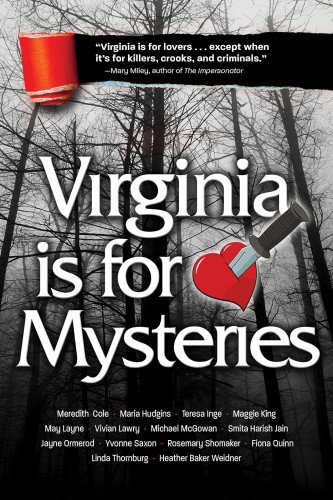
My short story, "Washed up" is in the first Virginia is for Mysteries.