Writing Mixtape - Writers Need Feedback

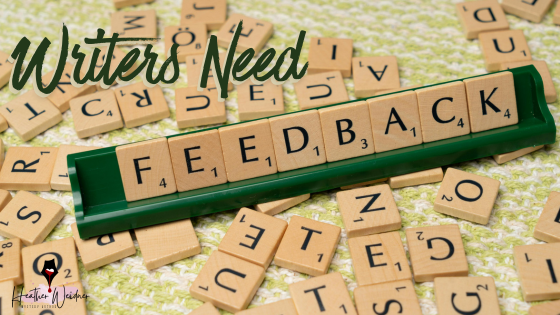
Research, writing, and revising are solitary tasks. Writers need feedback to ensure that their work is ready for publication, and it’s one of the hardest things for writers to do.

You have put a lot of blood, sweat, and tears into your work, and it takes a lot of courage to hand it over to someone who is going to make comments, positive and negative.

Writers need a critique partner, critique group, or beta readers to help them find plotholes, text that doesn’t make sense, and narrative that takes you out of the story and down a rabbit hole. They can help you find inconsistencies and overused words.

When I joined my first critique group, I thought my beautiful manuscript was ready for the world. (It wasn’t.) After critique group, it would take me a couple of days get the nerve to delve into the feedback. It was hard to read through that sea of red ink.

One key to feedback is that you as a writer need to review the comment with a clear eye and decide if it will improve your book. If two or three people mentioned the issue, then I would usually change it. If the comment changed my character drastically or my voice, then I may not make the alteration.

Good critique groups and partners and beta readers are worth their weight in gold. They can help you see what is in plain sight that you missed.

You are about to release your baby into a world full of readers and reviewers who can often be sharp-tongued with their opinions. Writers need to learn to not take feedback personally. It is hard. Negative points never make you feel good, but your goal is to make your work the best it can be.

Writing Mixtape: The Oxford Comma

I’m a GenXer, so I’ve decided to corral all my writing-related posts under the header of “Writing Mixtape.” Here’s my first entry…

Comma, Comma, Comma, Chameleon. Today’s post is on the Oxford Comma (the serial comma). It’s the punctuation in front of the conjunction when there is a list or a series of items. (The comma after “ice cream.” I like pie, ice cream, and chocolate.)

Using it or omitting it are both correct, and there has been a battle royal going on for years between the two camps. It all boils down to which style guide you follow. Book publishers tend to use the Chicago Manual of Style (#TeamOxfordComma), and journalists tend to follow the Associated Press Stylebook (#TeamNoOxfordComma).

The caveat is that the Oxford comma is recommended if there is confusion without it. For example:

My heroes are my parents, Godzilla and King Kong.

Without the serial comma, it looks like the speaker’s parents are Godzilla and King Kong. To make it clearer:

My heroes are my parents, Godzilla, and King Kong.

I have always been on #TeamOxfordComma. That’s the way Mrs. Hooper taught it in the third grade, and it stuck. It can be difficult for writers if your editors use different style guides. When they do, it’s a good idea to make a note, so that you follow their requirements. You’ll use your preference by default. Habits are hard to break.

What’s your preference?