What I Learned from Book Marketing 101

IMG_1605.JPG

My Sisters in Crime chapter hosted Book Marketing 101 recently with Mary Burton, Mary Behre, Tina Glasneck, and LynDee Walker. These amazing writers are a wealth of information. Here's what I learned.

  1. It is all about discoverability. You need to make it easier for your readers to find your book in a sea of books. You also need to find the best use of your time and resources while trying to reach the most readers.
  2. NetGalley and Book Funnel are good tools to use to get electronic ARCs (Advance Reader Copies) to your early readers.
  3. Offer street team/early reader group membership to super-fans. You need to keep your team energized.
  4. You own your mailing list. Build your list. Take a clipboard for sign ups to EVERY event.
  5. Facebook parties are a great way to celebrate your publication date. Be aware of the different time zones when you're scheduling yours. 
  6. When you know your publication date, work backwards and create a six-week calendar for promotions.
  7. Newsletter swaps are a good way to cross-promote. Find another author, and you create a newsletter for her list, while she does one for yours. It's a way to get information out to a new audience.
  8. Write your next book. Your back catalog helps sell your current book and vice versa.
  9. Google Mark Dawson. He is a good resource on Facebook marketing.
  10. Make sure you have an author page on Amazon and BookBub.
  11. Readers want an experience. Reach out and talk to your readers. Create an experience for them. They'll come back for another book.
  12. Add a sign up button to your Facebook page for your newsletter.
  13. Book clubs are the new book tour. Add a link to your web page for readers and book clubs. Let them know you'll visit or Skype with book clubs.
  14. PicMonkey and Canva are good tools for creating social media graphics.
  15. Readers love bookmarks. Sign them with a Sharpie if you leave them on a table or at an event. 
  16. Decide what your marketing budget is and where you are going to spend your dollars. have a plan.

These ladies were full of great ideas. There are so many ways to market your book. You need to find what works for you.

Logoverysmall.png


Proof of Alien Life or Just Story Ideas?

aaaa.png

You never know where story ideas will come from. Recently we installed two cameras outside. I have a blind driveway, I've always wanted to be able to see who drives up without having to run upstairs to look out a window or open a door. 

I never really knew what was going on in my front yard. And it's been fun. I like being able to see when packages are dropped off. Here are some other things we've "captured" recently.

I thought we captured proof of alien life when I saw this. I have no idea what this is. The bug looks gigantic on the camera. Hopefully, he and I won't meet. I may send this to the "What's Bugging You" team to see what kind of critter this is.

I'm not sure if this little guy was saying hello or attacking the camera. I'm pretty sure he's not the blue bird of happiness. 

And then there are the deer who eat my azaleas and tulips. They come through about every other night for a visit. 

My private investigator, Delanie Fitzgerald, and her sidekick/computer hacker Duncan Reynolds, use security cameras in their investigations. I'm going to expand the use in the next book and add some of the funny things that they might capture. I'm enjoying the videos from the unexpected in my front yard. And you never know where a story idea will come from...

Happy writing!

Logoverysmall.png

10 Book Marketing Ideas

books.png

I'm working with the final proofreader and the cover designer for my next Delanie Fitzgerald novel. It's slated to launch in November, and I'm really excited to share more of Delanie and Duncan (and Margaret's) antics. I learned a lot about book marketing and publicity with the first book, and I'm working on my plan for this one.

For the first book, I was new to the book marketing world. I'd worked with teams on publicity for anthologies. A lot of that knowledge transferred, but it is a little different when it is your book, and your book alone. 

Here are some ideas...

  1. This time, I'm putting pen to paper and defining my marketing plan. I had lists before, but I think planning out and coordinating my publicity will be more effective.
  2. Spread the word with blogs. I'm coordinating blog tours and guest blog posts again this time. It also helped with getting reviews.
  3. I'm going to put out newsletters this time. I've been collecting email addresses for a while, and I never put together a newsletter. 
  4. I'm going to continue to arrange appearances at book stores, book festivals, and other mystery events. I do quite a few author events throughout the year. I enjoy talking with readers and writers. 
  5. I sent out a few press releases last time. I'm going to coordinate this and expand my contacts.
  6. I always send an update to the "news" section of all my professional organizations and alumni groups. Last time, one college did a feature article on it, and the other purchased it for their library's alumni collection.
  7. I have an active social media presence. I added LinkedIn recently to my routine, and that has generated additional traffic for my blogs. Previously, I posted only my professional or "work" announcements there. 
  8. I'm going to coordinate a cover reveal this time to build up some excitement.
  9. I also plan to do more Goodreads give aways. Last time, that generated some buzz for the book.
  10. My Facebook and other social media boosts were more random last time. I'm going to do better at having a strategy for this book. 

I'm also looking forward to our Sisters in Crime - Central Virginia meeting next week with Mary Burton, LynDee Walker, Tina Glasneck, and Mary Behre. They're going to share their book marketing ideas.

What would you add to the list?

Logotiny.png

Pens, Paws, and Claws

logoborder.png

Our new blog, Pens, Paws, and Claws launches today, and I'm really excited to be blogging with a group of amazing writers: Kristin Kisska, Mollie Cox Bryan, Rosemary Stevens, Maggie King, Jeanne Adams, Judy Penz Sheluk, Sheri Levy, Barb Goffman, and Teresa Inge.

My first post appears today. Please stop by for a visit. I interview Lauren, a teen puppy trainer for Guiding Eyes for the Blind.

Lauren and Wheat.jpg
paw.jpg
Logotiny.png

Collaborating on a Mystery Party Script

DSC_6813.JPG

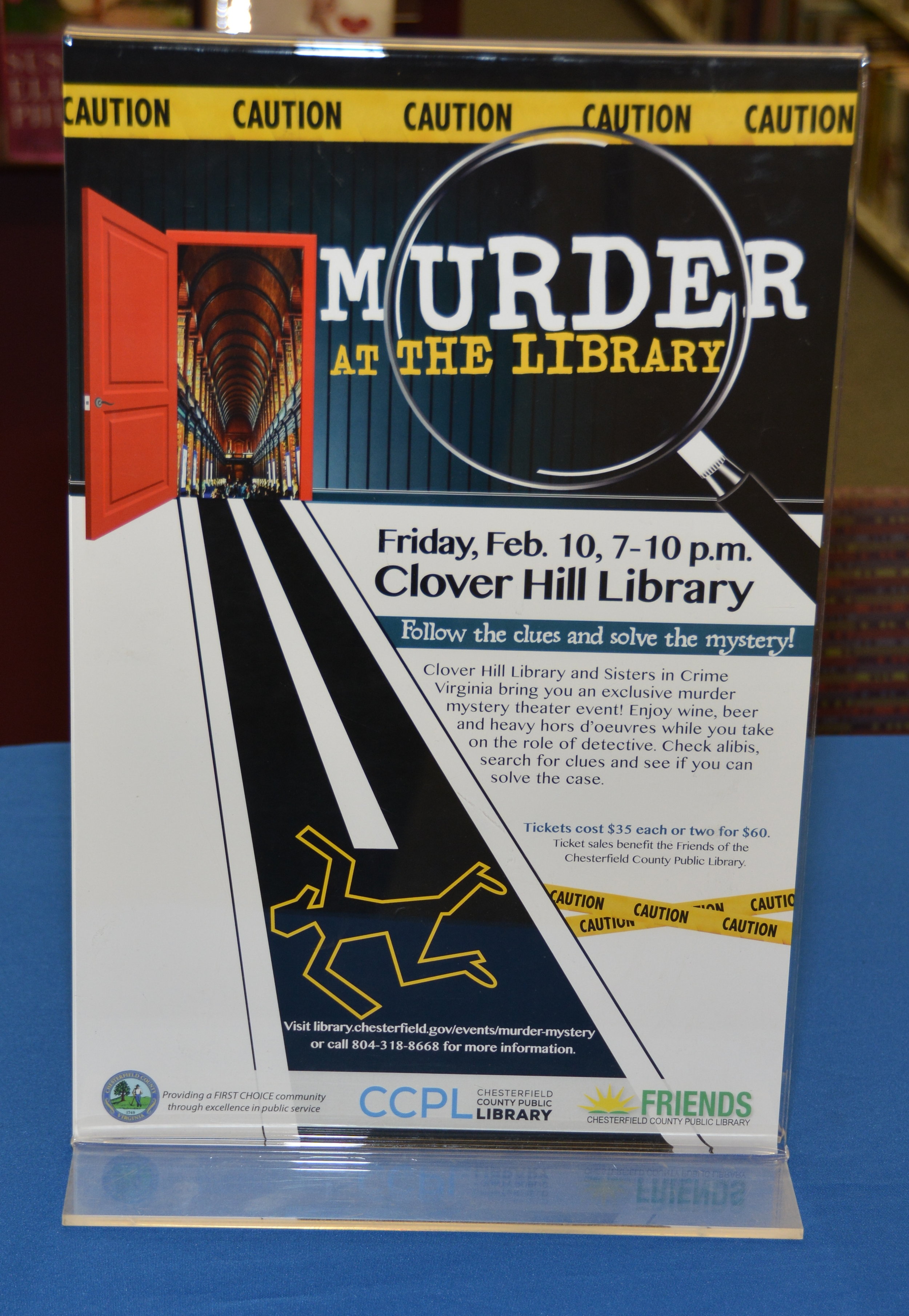
For the past few years, my Sisters in Crime chapter volunteers have been asked to write a script for our library's fundraiser. We write the script, and the very talented librarians and staff bring the play to life. On the night of the event, the guests are divided into two groups. One views the mystery clues, and the other attends an author panel. They switch. Then there's time for the guests to interview the actors and look for clues. Afterwards, there is the big "who dunnit" reveal and a book signing.

The first two years, we killed off the head librarian and the children's librarian. The next event has even more surprises. I met with Mary Miley and Rosemary Shomaker yesterday to create the characters and plot the murder. The collaboration was a lot of fun. Writing is usually a solitary sport, and it was neat to bounce ideas and motives off each other. I just hope the folks in the next booth didn't think we were plotting a real murder.

This event has sold out in the previous years. And it is such a thrill for me to see something we created brought to life. The actors do such a good job of filling out the characters and making the scenario seem realistic. Each guest gets a handout with a list of all the characters and room to make notes. At the end, they vote on who they think the guilty person is.

Here are some things we do to prepare the script.

  1. Work with the library's planning team to get an idea of themes and interests for the event.
  2. Come up with the crime (usually a murder) and build clues around it. It needs to be something that can be done either on or off stage. (The first year, the guests were invited to an event, and they arrived to find the police investigating the head librarian's murder. The next year, the guests were attending a concert by a popular children's musician, and there was a murder.)
  3. Create an interesting/zany cast of characters. Each character needs to have some distinguishing characteristic that the actors can exploit.
  4. Name the characters so that there's not confusion about who did what. You don't want a Kevin, Kyle, and Kurt. 
  5. Think of characteristics or props that the actors can use. The planning team seeds the library with clues and red herrings. 
  6. Make sure that every character has some combination of means, motive, or opportunity. The guilty one should have all three. 
  7. Ensure that there are ways for the audience to get the clues they need (e.g. through action, dialogue, or questioning the suspects). 

I'm looking forward to the next murder mystery evening. I can't wait to see what the actors do with our latest script. 

Logotiny.png
DSC_0188.JPG

20 Word Tips for Authors

Word Tips.png

Microsoft Word has thousands of features that I never use. I was poking around this week and found some neat tips that could help authors. I tried these in Word 2010 and Office 365. 

1. If you don't like the little squiggly lines under words you know are correct, then right-click onthe word. You can choose to ignore it in the current document, or you can add it to your dictionary, so it won't be marked again in any document. (Just make sure it's spelled correctly before you add it to your dictionary.)

2. If you want to number the rows in your table, create a table (Insert; Table; Insert Table). Put the cursor in the first cell of the column you want to number. Highlight several cells in the column. Go to the Home tab and click the down arrow next to the numbering icon. Select the style you want. As you add rows, they will number automatically. If you delete a row, the numbers will adjust.

3. To total the numbers in a column of your table, create your table and fill in your numbers. Put your cursor in the empty cell at the bottom. Click the Layout tab under Table Tools. Click the formula icon. When the box appears with =SUM (ABOVE), click Okay. Note: If you change the numbers in the column, you will have to repeat these steps to get a new total.

4. To convert a table to text (without the table formatting), go to your table and highlight it. On the Layout tab under Table Tools, click Convert to Text.

If you select the tabs option, your columns will be tabbed with out the rows, columns, and grids.

If you select paragraph marks, it will put the contents of each row in a new paragraph.  

If you select commas, it separates the values of each column with commas.

5. To remove a hyperlink or email address, highlight the text and right-click. Select Remove Hyperlink (or Remove Link in Office 365).

6. To create a hyperlink, select the word or phrase in your document. Right-click and select Hyperlink (or Link in Office 365). In the address field, paste or type the URL/link. Click Okay.

7. Sometimes, when you submit to contests or anthologies, you're asked to remove all personal content from your document. Save your document. Click the File tab. Click Check Info (in the pane to the far left). Click the Check Issues button. Click Inspect Document. When the Document Inspector appears, select what you want to check. Click Inspect. The results window will appear. Click Remove All to correct any issues and save your document.

8. If you want to create a new page in your document, hold down Ctrl and Enter.

9. Sometimes, you need to add a break to your document. Put the cursor where you want the break. Click the Page Layout tab (Layout tab in Office 365). Click the Breaks icon (on the Page Setup section. Select the type of break you want.

10. To add a watermark (faint text in the background) such as "draft," put the cursor on your page. Click the Page Layout tab (Design tab in Office 365). Click Watermark and choose your design. Remember that the Remove Watermark is here in case you want to take it off of a document later.

11. If you want to add a page border to your document, click the Page Layout tab (Design tab in Office 365). Click Page Borders and select your choice. Click Okay.

12. To change the background color of your page, click the Page Layout tab (Design tab in Office 365). Click Page Color and select your choice. Click Okay.

13. Click Shift and F5 to move your cursor to the last location from your last save. This is a quick way to move to where you left off. (Office 365 has a pop-up bubble when you open your document to do the same thing.)

14. If you continue to press Shift and F5, your cursor will move to each place you have edited recently.

15. Sometimes, you need filler text for a layout (like a flyer or poster).  Microsoft Word will create it for you. Move the cursor to the place in your document where you need filler content. Type =lorem (p,l). Enter a number in place of the "p" and "l". "P" is the number of paragraphs, and "l" is the number of lines you need (e.g. =lorem (5, 50).

16. To quickly research a term, highlight the word/phrase and right-click. Click Lookup (Smart Lookup in Office 365). Choose your option, and your information will appear in the pane on the right. 

17. To delete an entire word, hold down Ctrl when you press Backspace.

18. Normally, if you click and drag the cursor to highlight an area, it highlights sentence by sentence. To change the shape of your selection (to select in a rectangular area on your screen), insert your cursor and hold down Alt as you drag.

19. If you hold down Ctrl as you click, it will highlight the entire sentence where the word you selected is located.

20. You can use Word to view two documents at the same time. Click the View tab. Arrange All lets you see more than one document. Arrange All stacks them on top of one another. If you click the View Side by Side button, they're arranged horizontally. You can use the Arrange All with more than two documents. The View Side by Side button allows you to choose only two documents to see at a time.

What else would you add to the list?

Logoverysmall.png


Plan B - Computer Tips for Writers

22.jpg

I work in IT, and we're always preparing for outages and how to recover from disasters. We have a plan B or a work-around for lots of scenarios, so that our users can continue working if there is a disruption of service.

As a writer, your computer and other tools are part of your business, and your writings are valuable. You need a back up plan if something goes wrong. If you've ever lost a file or had a computer die on you, you know that sinking feeling. Here are some tips that can help.

  1. You need to backup your files regularly (on an external harddrive or to the cloud). Find the way that works best for you. Make sure that backups are part of your routine. Your work is too important to lose.
  2. Check with your website/blog provider to ensure that backups are part of your plan. It's a lot of work to recreate your site if something catastrophic happens. 
  3. Keep up with emails from your website/blog provider and other software services. If your subscription runs out, your access is revoked. Make sure to keep copies of all of your receipts.
  4. Make sure that you have anti-virus software on your computer. There are a lot of services out there, and you need to find the one that works best for your. Attacks, viruses, and malware unfortunately are a part of daily life.
  5. If you signup for software services, often there is an auto-renewal feature. If you leave it on, make sure you know when it's time to renew and that you want to continue the service. If you turn it off, make sure that you renew at the proper time. See #3. Be aware that it could expire and you lose access.
  6. Keep all of your passwords in a safe place (not in a spreadsheet or Word document on your computer). I use KeePass. It's a password locker, and it's free. You just have to remember the one password to access the application. 
  7. You may want to back up your contacts. You can export a list and save it outside of your email software. This list is hard to recreate if it's damaged or inaccessible.
Logoverysmall.png

33 Seconds or Less - What I Learned from the Shoot/Don't Shoot Simulator

My Sisters in Crime Central Virginia chapter visited the Richmond Police Training Academy recently and triedthe "Shoot/Don't Shoot" simulator. Growing up as a cop's kid paid off. Many thanks to Captain Harvey Powers for all the simulations, background information, and law enforcement lessons.

I know it was a simulator -- but my adrenaline was pumping and my knees were shaky when it was over. I had an epiphany while watching the simulations. All that response and nerves and shoot/don't shoot decisions happened in a span of less than 33 seconds. And police officers have to face that moment multiple times a day. 

Here's what I learned from my two simulations and watching the others in my group. (My first simulation was a speeding car/traffic stop, and the car didn't have license plates. The driver pulled a gun. My second simulation was an active shooter in a middle school.)

  1. The ability to diffuse a situation with verbal skills is a key skill set for law enforcement. And it may be difficult to find folks with those skills in the texting generation.
  2. You have to be in relatively close proximity for pepper spray to be effective (about ten feet). There can easily be blow back, and you don't want to spray it in an inhabited area. Every Richmond PD cadet gets sprayed with pepper gas in training. And it takes about an average of 30 minutes to wear off.
  3. Pepper spray works on animals. It is basically odorless. It has less of an impact of people who eat really spicy food regularly.
  4. A taser (is not a phaser), and it has two sets of charges. It shoots two parallel lines that have what looks like flattened fishhooks on the end. When the trigger is pulled, a red laser dot appears, and it takes about five seconds to discharge.
  5. Lethal force is used to protect the lives of others and the officer.
  6. Real police do not fire warning shots in the air (bullets come back down), shoot guns out of the bad guys' hands, or shoot out tires.
  7. Officers are trained to aim for center mass (not kneecaps).
  8. Police officers are trained to Ask, Tell, and Make when they give commands.
  9. "Cop" comes from Conservator of the Peace.
  10. Be smart. Have and use your verbal skills to diffuse tense situations before they escalate.
  11. Know the fear and overcome it.

I think everyone needs to experience the "Shoot/Don't Shoot" simulator at least once. It gave me a new perspective on what police officers have to deal with every day. Growing up, I knew my dad faced danger, but I didn't realize how often a call can turn dangerous. 

Logoverysmall.png