Don't Go It Alone - Find a Writer's Group

It can be lonely in your writing cave. Writers need to find their groups. It's important to have others to chat with, brainstorm ideas, and share celebrations (and setbacks). I am very fortunate to be a part of several writing groups.

I've been a member of Sisters in Crime for almost seven years. It's a wonderfully supportive group of mystery and thriller writers. Our local chapter has programs and opportunities for our writers. We've partnered with another chapter to produce two short story anthologies to provide our members publication and book marketing opportunities.

Several of our published authors in our chapter created Lethal Ladies Write. We blog together and promote each other on social media. We also partner for book signings and workshops. My chapter also has a critique group, and their feedback on my works in progress is invaluable.

I am also a member of SinC's online chapter, the Guppies (The Great Unpublished). It's another supportive group, that even when folks are published, they hang around to offer assistance and information. They offer online workshops, training, and listservs for a variety of interests.

I joined James River Writers last year, and I wondered what took me so long. It is based in Richmond, VA. This group celebrates and supports all kinds of writing. It offers programs, workshops, and an annual writing conference that grows and grows every year.

Each of these groups off me support, new ideas, advice, and comradery. And they also help me to understand that I'm not alone on my writing journey. Sometimes, I need to be reminded of that.

There are a variety of writing groups out there, some local and others online. Some are genre-specific, and others are more general. Here are some you should check out:

What I Learned from "Murder Shorts - Short Stories"

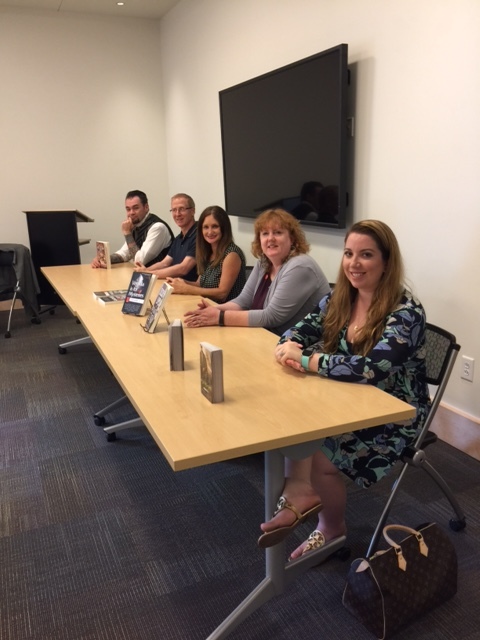
I attended "Murder Shorts - Short Stories" at Malice Domestic 2017. Here's what I learned from this fun bunch of short story authors: Leone Ciporin, Teresa Inge, KM Rockwood, Alan Orloff, and Maggie King.

  1. The group liked the short story format. They felt they could experiment more as writers in this compact format.
  2. Short stories are seeing a resurgence. Check out Spine Tingler Magazine, Flashbang.com, Mystery Weekly, and Woman's World. They all pay for mystery submissions.
  3. Visit Sandra Seaman's blog to see calls for publication for short stories.
  4. Readers care about the characters in short stories. The characters are often ordinary people in ordinary settings.
  5. Characters are important in short stories. Description and dialogue help create the picture for the reader.
  6. I loved Alan Orloff's advice for writers - BIFOK! (Butt in Chair; Fingers on Keyboard). You just have to sit down and write.
  7. You have a small space in a short story; every word must count.
  8. Use both sides of your brain when you write. Your creative side writes and plots, while your analytical site proofreads and edits.
  9. Don't edit as you write. Just write. Revise later.
IMG_0800.JPG

My 2017 Wine Tour - Stop #2: Mermaid Winery - Norfolk, VA

Yesterday, we had a book signing for 50 Shades of Cabernet at the Mermaid Winery in Norfolk. It's billed as Virginia's urban winery. This is such a great place. I grew up in Tidewater, and I hardly recognized W 22nd Street. The city is alive with so many neat places, and the Mermaid Winery is definitely a place you need to check out. The food, atmosphere, and staff were wonderful.

Okay, I'm a wine novice, so I'm learning a lot on this wine/book tour. The Mermaid Winery has metal glass holders for those doing tastings. I loved the tree of wine glasses.

The staff set up a wine tasting for our book launch. I spotted a glass with a pretty shade of red at the bar. I asked the wine steward about that particular wine, and she replied, "That's the dump cup." I've still got a lot to learn.

18403221_10211483549197184_7280591740172655206_n.jpg
Back Row l-r: Jayne Ormerod, Kristin Kisska, DJ Lutz, Ken Wingate Front Row l-r: Teresa Inge, me, Rosemary Shomaker, and John Koehler

Back Row l-r: Jayne Ormerod, Kristin Kisska, DJ Lutz, Ken Wingate Front Row l-r: Teresa Inge, me, Rosemary Shomaker, and John Koehler

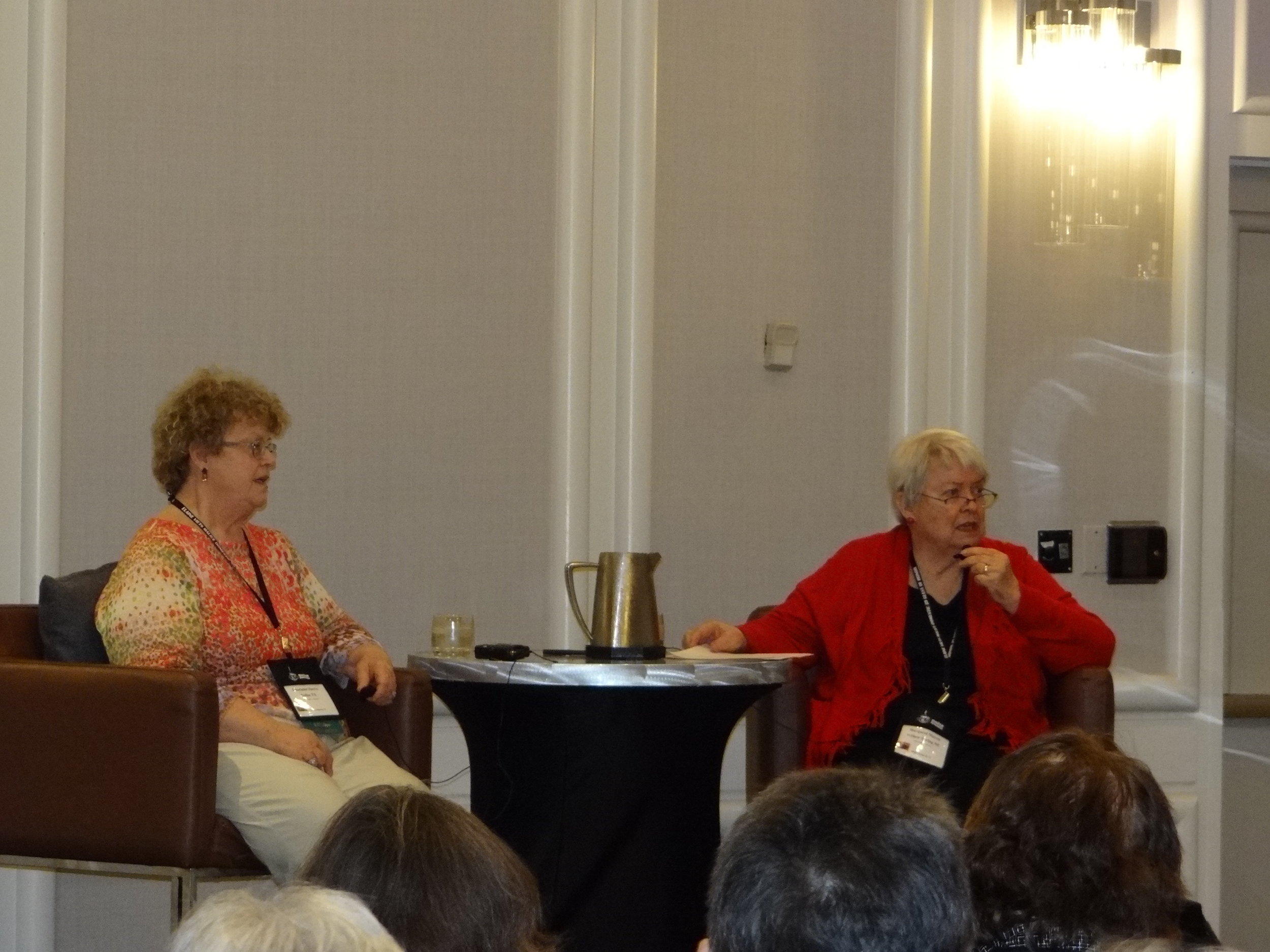
What I Learned from the Fabulous Charlaine Harris

At Malice Domestic 2017, I attended an interview with the very talented and funny Charlaine Harris. Here's what I learned about her and her writing.

  1. The best example you can set for a child is for them to see you reading. She said that she grew up in a house full of avid readers and books in every room.
  2. She said that she writes personal stories with one character or a small group of characters.
  3. We all face struggles that cause us (or our characters) to make decisions. As a writer, you need to think about the choices your characters make.
  4. She said that she's a pantser (one who writes by the seat of her pants) because that's the fun of writing. It's exciting to see what happens. She likened outlining to paint by numbers.
  5. She said she started writing about the paranormal because she wanted to do something different to make money. She said that she's always been interested in things we can't see or hear.
  6. She said that she often writes about the south in many of her books. She talked about southern charm and living in Arkansas and Texas. She was asked what was something about southern culture that she had to explain to folks in other areas. She said that y'all is plural. And she wanted to let people know that there is more than one southern accent. Not all southerners sound the same.

I love listening to other authors talk about their paths to publication. Ms. Harris was charming and gracious and so willing to share her experiences.

How to Survive Writing/Book Conferences

I love writing and book conferences. These are good ways for authors to network with readers, writers, fans, bloggers, and others in the publishing industry. I learn so much at each one. Here are some hints that I've picked up along the way that can help you navigate events and networking.

  1. Wear comfortable shoes. My Fitbit always gets a workout.
  2. Keep emails about events (with the contact information) that you're scheduled to attend. I always keep a folder with emails and receipts. It makes it easier if you have to remember a name or a time.
  3. Plan out your day of panels, workshops, and activities. Know where the rooms are. I went to one conference where the events were in two different hotels.
  4. Wear layered clothes. Conference centers are often too hot or too cold.
  5. You're going to get a lot of books and swag. Make sure you have room to get it all back home. Many conferences have mailing centers to ship items.
  6. Carry bookmarks and business cards with you. You'll network everywhere, and it's a good idea to have items to share.
  7. When you do panels, workshops, or signings, bring a copy of your latest book. It creates a visual for the audience. I bought some portable book stands, and they work great to showcase the latest novel.
  8. Have your supplies handy (e.g. bookmarks, give-aways, business cards, pens, etc.) I have an emergency box with extra pens, scissors, and tape.
  9. Take lots of pictures for social media posts. I learned years ago from a social media guru to post regularly during conferences. Use the event hashtags and tag people that you network with.
  10. Bring a notebook or paper. Even if I'm on a panel, someone says something that I want to jot down. These events are a great exchange of ideas.
  11. If you're doing an event, make sure you have give-aways. Candy is always good (especially chocolate)! Many conferences have hospitality rooms where authors can leave bookmarks or postcards.

These are photos of my adventures at Malice Domestic 2017.

L-R: Rick Ollerman, Robert Downs, Elena Hartwell, Mary Ellis, and Me

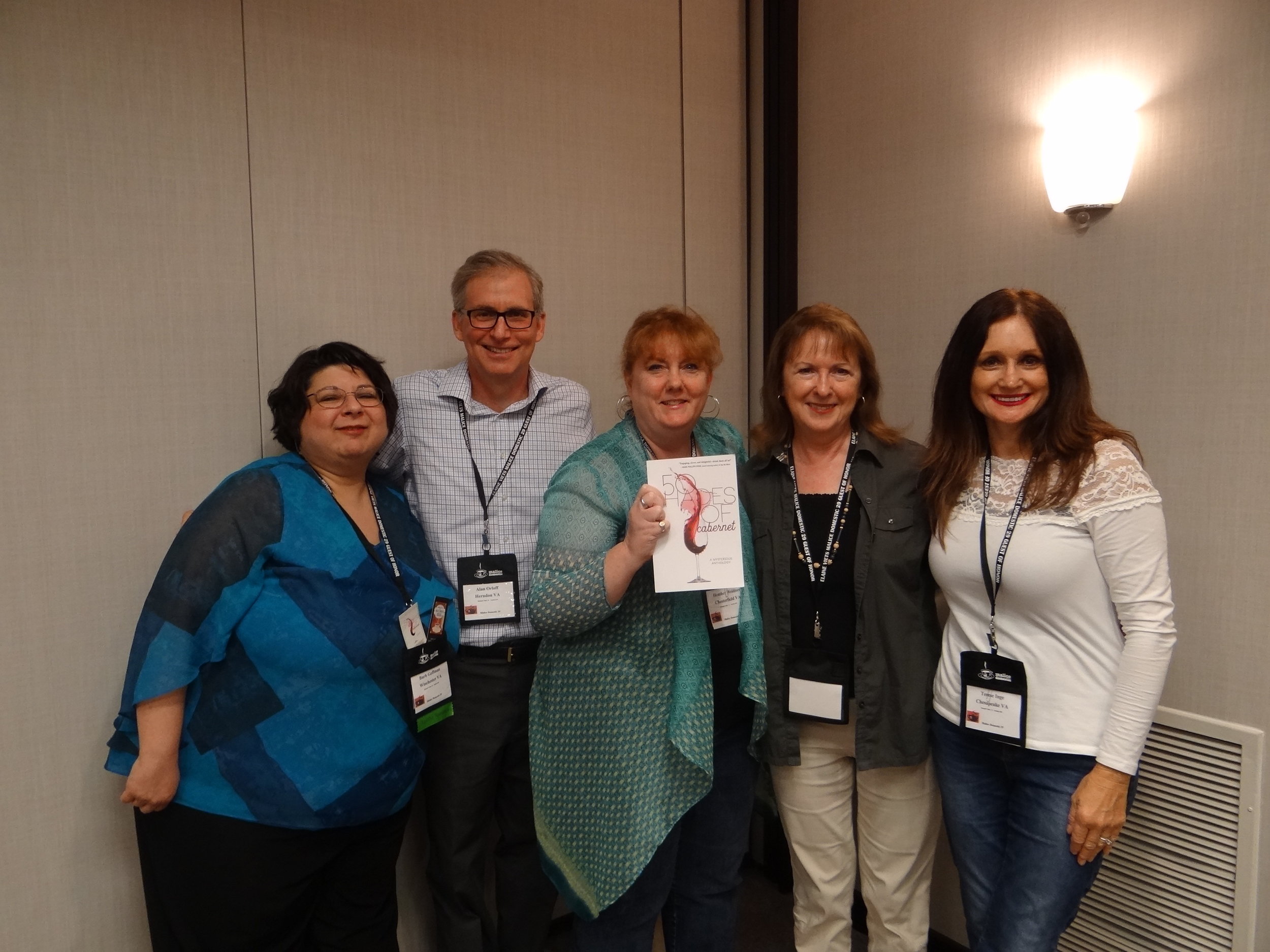
L-R: Barb Goffman, Alan Orloff, Me, Maggie King, and Teresa Inge

L-R: Barb Goffman, Alan Orloff, Me, Maggie King, and Teresa Inge

Me with Edith Maxwell at the Malice Banquet

Me with Edith Maxwell at the Malice Banquet

Me with the Wonderful Charlaine Harris

Me with the Wonderful Charlaine Harris

What I Learned from Author Jenny Milchman

L-R: Heather Weidner, Rosemary Shomaker, Jenny Milchman, Mary Burton, Kelly Justice

L-R: Heather Weidner, Rosemary Shomaker, Jenny Milchman, Mary Burton, Kelly Justice

Suspense author, Jenny Milchman, spoke to our Sisters in Crime chapter at Fountain Bookstore in downtown Richmond, Virginia. She talked about her writing journey and what happens after the contract. Here's what I learned.

  1. Her path to publication was a thirteen year process. Don't give up!
  2. Face-to-face contact is vital in our virtual world. Make sure you attend events and conferences to network with readers. You never know who will be there.
  3. Persistance is key for those who want to be published writers.
  4. Your first published novel may not be the first one you wrote.
  5. There are two kinds of writers: one that thinks everything he/she has written is terrible and the other is the kind that thinks every word he/she has written is golden. Where do you fall?
  6. Signing with an agent doesn't mean that the agent will be able to sell your book.
  7. There are a lot more choices these days for new authors to publish and build a readership.
  8. Don't forget the people who helped you along your publishing journey.
  9. Sometimes, it's all about being with the right book at the right time and place.
  10. Find a writers' group that is supportive. You're not alone in this.
  11. Just becauseyou have a book contract doesn't mean that that publisher will want every book you write.
  12. Make sure that your newsletter has good content. Don't always make the focus your book. Include anecdotes, your pets, recipes, etc. You need to connect with people.
  13. If you're going to use a publicist, ask around to make sure they are known in the business. Your local booksellers are a good resource for this.
  14. Target your book publicity about events to people who live near the event.
  15. Social media posts with pictures do better than those without.

My 2017 Wine Tour - Stop #1: Farmville, Virginia

I am fortunate to be a part of a new wine-themed mystery anthology, 50 Shades of Cabernet with some talented authors: Barb Goffman, Teresa Inge, Kristin Kisska, Jayne Ormerod, Maria Hudgins, Lyn Brittan, Douglas Lutz, Alan Orloff, Debbiann Holmes, Betsy Ashton, James M. Jackson, Tina Whittle, Maggie King, Nancy Naigle, Rosemary Shomaker, Jenny Sparks, and Ken Wingate.

As part of the book promotion, we're visiting wineries, wine shops, and festivals up and down the east coast. Here's my disclaimer: I am a wine novice. I prefer iced tea and Dr. Pepper, so I've got a lot to learn. In college, we drank wine out of cardboard boxes, and I tend to pick vintages by the label design or the name. I'm hoping I'll learn more this spring and summer about vintages, grapes, and styles.

Last weekend, we attended the Farmville Wine Festival, a fundraiser for Meals on Wheels, in downtown Farmville, Virginia. The weather and the band were great, and our mystery anthology pairedwell with all the wines. It was a lot of fun to meet wine lovers and mystery fans. We quickly spotted the wine festival pros at the event. They sported a variety of wine glass slings or necklaces. One lady explained to me that a good one should be able to accommodate a stemmed or a stemless tasting glass.

Many of the slings/necklaces were utilitarian, while others were personalized with sayings and sequins. I had never seen one of these before. I'm going to have to find one for mystery writers.

We also had the pleasure of meeting Christopher Brochon from WFLO in Farmville. He was a wealth of information about wines and flavors. I appreciate all of his insights. The booth next to us offered tomato and pumpkin wines. I didn't have time to stop for a tasting, but I was curious about the tomato one.

Our next stop will be the Mermaid Winery in Norfolk, Virginia in May, and I'm looking forward to the next adventure.

What Do You Do When You Don't Feel Like Writing?

Sometimes, life gets in the way, or I just don't feel like writing. I know I should write every day. I also know that the longer I stay away from my work in progress (WIP), the longer it takes to get back into the groove. But there are days I don't feel like it. Here are a few ideas to get recharged and back on track.

  1. Write a blog post. Usually, the act of writing something gets me moving, and then I can return to my WIP.
  2. Go on a walk or exercise. When the endorphins kick in, the energy level goes up.
  3. If you sit for long periods of time, It may be time to take a break for a meal or snack. I'm a caffeine junkie, so a recharge may be in order. I have two Jack Russell Terriers, and they let me know when we've been in the office too long.
  4. Sometimes, I need a day off. Grab your camera and go somewhere for an adventure.
  5. Take a quick break and do a chore or two. The physical activity changes moods.
  6. Try a creative project other than writing.
  7. Find a new place to write. Go somewhere or go outside. A change of scenery is often nice.
  8. I keep notes for each novel and a character list. Sometimes, I go back and revise these and after a little while, I'm ready to get back to the WIP.

You may need a break, and it's good to get away from your writing project every once in a while. Just don't stay away too long. I'm a binge writer. I work full-time and have an active volunteer life. I try to make time to write every day, but it doesn't always happen. Don't beat yourself up. Take a break when you need it.

What do you do when you need to get away from your writing?