19 Things I Learned about LinkedIn

This week, I attended a seminar, "The Power of LinkedIn" by Bridget McGovern, Senior Nonprofit Relationship Manager for LinkedIn. She provided a good overview of the platform and a workshop for us to improve our sites. Here's what I learned...

  1. Your profile is your professional brand. How do you want to look to others? Your brand is your promise of what others can expect of you.
  2. Your LinkedIn profile is not your resume.
  3. Follow organizations and causes you care about.
  4. You are the brand ambassador for you and your company.
  5. Networking is key. Make connections.
  6. When you send a connection request to someone, make sure to personalize it (e.g. Hi, John Doe. I enjoyed meeting you at the ABC Conference in Atlanta.). I sent one recently from the mobile version, and it didn't let me personalize the request.
  7. Your profile should show where you've been, where you are now, and where you're going.
  8. Seventy-five percent of hiring managers use LinkedIn to look for and at candidates. Hey hiring managers, candidates look a your company and profiles too.
  9. Make sure you have a professional looking headshot. It can show your personality. Just be careful with selfies. Profiles with pictures get 21x more views.
  10. Your photo should be from the shoulders up, and you should smile.
  11. Your summary should be short - no more than two paragraphs. This should be your elevator pitch about you. What do you bring when you walk into a room?
  12. Add a custom headline under your photo - not just your current job title. This allows you to be creative in your description of yourself. State the essence of what you do.
  13. Keep your experience concise (about two sentences). Highlight the value of what you brought to the team.
  14. Think about publishing content, photos, and videos. This increases your reach.
  15. Your skills tell your story. If someone endorses you for something, and it doesn't fit, you don't have to accept it.
  16. Make sure to include your volunteer experience.
  17. Connect with people you know, people who belong to similar organizations, and your alumni groups.
  18. Look at groups and join what interests you. This is another way to network.
  19. Be creative and don't be afraid to show your personality in a professional way. You don't want to look like a robot. Sometimes, we're too formal in our descriptions, and when others read it, it's bland or boring.

I learned a lot from Bridget McGovern. I've had a LinkedIn profile for a while, but I don't do that much with it. I have noticed over the last year that I'm getting more and more recruiters send me information on jobs they think I'm a fit for. It's nice to be noticed. I'm off to revamp my profile.

How to Do a Quality Review for Your Writing

I am an IT Quality Assurance and Governance Manager by day, and that means I read, review, and write a lot of policies and procedures. My team is also responsible for reporting on progress and enforcing policy. I spent most of last week conducting quality reviews on a variety of IT documents. There are certain standards that need to be followed before the work is accepted. Self-editing is a lot like a quality review. Here are some items that you need to check as you review your work and prepare it for publication.

  1. Start off with your basic spell check to catch obvious typos. Just be careful, some of the grammar suggestions are not correct.
  2. Check the spelling of any brand names you use. Make sure they are spelled and capitalized correctly. (e.g. Post-it Notes, BAND-AID, etc.) Also make sure that you're not using a brand name to refer to a generic item.
  3. Make sure that your word use is consistent with capitalization and hyphenation (e.g. database or data base; tshirt, Tshirt, or T-shirt).
  4. Check your headers and footers. Is all of your contact information correct?
  5. If you manually typed the chapter numbers, go through each and make sure you didn't skip or duplicate any.
  6. Check all of your names and place names - especially if you made changes during editing. My friend renamed a character, but when it went through critique group, she found that she hadn't changed all of the instances. We were all wondering who this new character was who just appeared out of nowhere.
  7. Be consistent with your use of numbers. Do you write them out or use digits? If you're using digits, you shouldn't start a sentence with it; write out the word.
  8. Look for overused words. I have a bunch that I tend to repeat (and repeat). I have a list, and I add to it when I find more culprits. Use your search/replace to locate and eradicate them. My big offenders are "just" and "that."
  9. Change the view on your word processer to a small percentage (e.g. 25%) so that you can see a lot of pages at once. Look at the lengths of your chapters. Are they balanced? Sometimes, I find I have a bunch of short chapters and then a series of really long ones. If possible, try to even these out.
  10. If you don't have a writing partner, critique group, or beta readers, you should invest the time and find one that works for you. Real peer reviews are invaluable. I am part of a mystery critique group, and the advice and support are wonderful.

Hosting a Facebook Hop to Promote Your Book

Recently, I organized a Facebook Hop for our anthology's prelaunch. I'd participated in several and found it was a great way for authors to share connections and to find new fans and readers. A Facebook Hop is an online event that starts at your book page and connects a group of authors by linked posts. Guests start at the first site and hop through each, registering for the give-away.

Here's what I learned from putting the event together.

  1. Before you begin to plan your event, check Facebook's terms and conditions about contests. They do change, and you want to make sure that you're following all the rules.
  2. Recruit authors about 3-4 weeks before your event.  Have a recruitment email ready with all the pertinent information. Decide up front if you want all authors from a specific genre or not.
  3. When the authors sign up, create a spreadsheet and collect names, emails, phone numbers, links to the author Facebook pages,  the prize, and an estimated prize value. I didn't put the individual prize values on any of the materials. I just used it to total the amount for all the sites (e.g. Over 25 authors and over $750 in prizes).
  4. Arrange the order of the hop, starting with your page. You will want to mix up the prizes. We had a lot of ebook and book give-aways. I mixed these in with the gift cards, jewelry, and other things.  Make sure to put at least a couple of valuable items at the end to keep people interested in all the stops.
  5. Make sure that all of your participants have an AUTHOR page.
  6. Have a cut off date for recruiting and stick to it. Avoid adding authors. If you do, you have to go back and redo links.
  7. Send an email to each author with the verbiage for the post, the artwork for the event, and a link to the next person. It took a little time to compose all of the emails, but it made the process easier for the participants.
  8. Instruct the authors to schedule their post for the designated time and pin it to the top of their newsfeed. (I had to include instructions for both of these tasks in the author email.)
  9. Specify the time for the hop to your authors and fans in the time zone you're in. We had folks from all over the world participate (e.g. 6:00 AM EST April 1 - 12:00 AM EST April 3).
  10. We let each author pick his/her winner and post the name when the hop was over.
  11. If you have rules or procedures, let everyone know them up front (e.g. like authors with hop stops shouldn't participate).
  12. Get all of your participants to help advertise the event. It's a great way to share fans and readers.
  13. Do not plan to do anything the morning that the hop goes live. You'll need to check all of the links. We got almost to the end before we hit a broken link. I spent several hours that morning helping a couple of authors get their posts updated.

50 Shades of Cabernet

I am excited to be a part of the 50 Shades of Cabernet mystery anthology with such a talented group of authors. My partners in crime are Barb Goffman, Teresa Inge, Kristin Kisska, Jayne Ormerod, Maria Hudgins, Lyn Brittan, Douglas Lutz, Alan Orloff, Debbiann Holmes, Betsy Ashton, James M. Jackson & Tina Whittle, Maggie King, Nancy Naigle, Rosemary Shomaker, Jenny Sparks, and Ken Wingate.

In my story, "Par for the Course," Mona McKinley Scarborough, the family matriarch doesn't take no for an answer. When she's not successful at convincing her granddaughter Amanda to make the right career choice - to join the family's winery, she plans a golf outing as a chance to draw them closer together. Their chat reveals some deadly secret, and they learn that the grape may not fall far from the vine.

The Scarborough family, who can trace their roots back to Jamestown, Virginia and the colonists, has been a fixture in Richmond's capital society for more years than anyone can count. Their roots and dirty little secrets run deep. I like my mysteries to have lots of twists and turns, and "Par for the Course" takes on several meanings throughout the tale, where we learn that some family secrets are as dark as the cabernet.

The anthology is available at your favorite bookseller. It's a fun book club or beach read, especially paired with your favorite wine.


What I Learned from Hosting an Author Facebook Party

As part of our recent launch for our mystery anthology, 50 Shades of Cabernet, we scheduled a Facebook party. It was a great way to interact with fans and friends. And we created some buzz about the book. Here's what I learned from our virtual party experience.

  1. If you're planning on having a give-away or contest, make sure you read Facebook's Terms and Conditions on contests before you start your planning. These change from time to time, so you need to make sure you have the latest information, so you don't violate any agreements. (In Facebook, click on Settings and select Terms.)
  2. Schedule your event in advance. Think about the time for the party. You don't want to limit it to just your time zone, but you don't want to commit to a large time block either. Ours lasted three hours.
  3. Recruit author friends to stop by for a specific time. We had a group of authors, so we divided up the time slots. You want people who will chat, ask questions, respond to questions, and keep the conversation going.
  4. Divide your party into 30- or 60-minute blocks for the authors to staff. Ask them to sign up for a slot. We also invited them to stay as long as they wanted, and many stayed longer than their hour.
  5. Plan your give-aways. We offered some each hour, so we asked the authors to sign up for these too and let us know what the prize was. We spread these out throughout the evening. And many of the guests stayed to see what the next prize was.
  6. Decide if you want your party to have a theme. We decided that our book launch was the focus. We talked about the book, our stories, wine (the theme of the anthology), and all things writing. Each author had some questions to throw in to keep the conversations going. Make it fun! Many of the authors posted a picture of the wine they were drinking and where they were at the time of the party.
  7. We were going to have different threads or Facebook posts for different topics and give-aways, but some of the guests got confused, so we kept all of the conversation in one thread. You'll want to decide the logistics before you start the party.
  8. Remind your guests and authors to refresh their pages frequently.
  9. Publicize your event about two weeks in advance. Create a Facebook event and invite guests. Have all of the authors share the event and talk it up on their social media sites.
  10. Make sure you specify the time zone for your party, so folks in other areas don't miss your event.

8 Writerly Things I Learned at Mysterypalooza

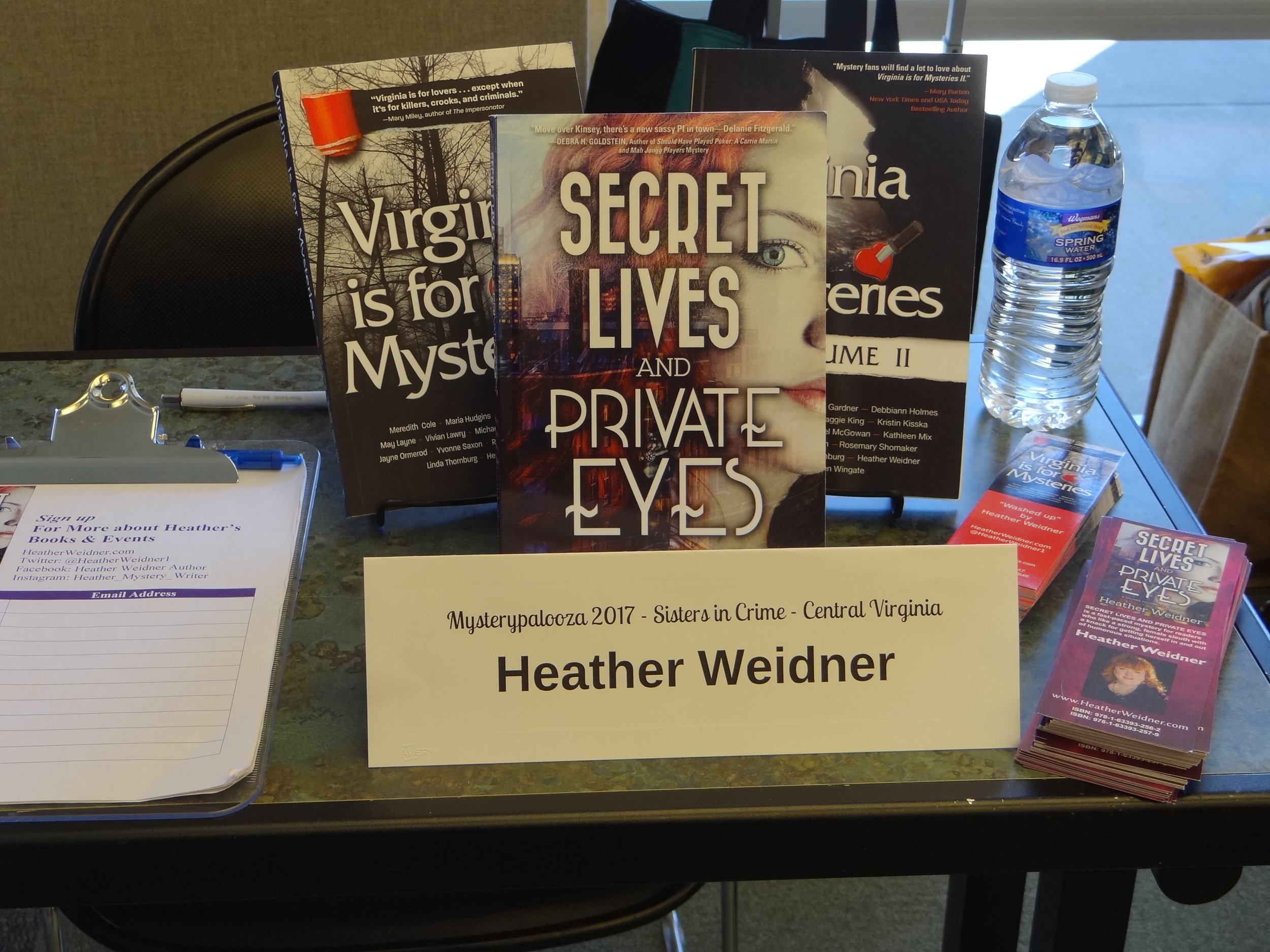
Sisters in Crime - Central Virginia hosted Mysterypalooza last weekend. It was our chapter's 30th Anniversary Celebration for Sisters in Crime, and we had such a fun event. Mary Burton, Mary Behre, Tracey Livesay, LynDee Walker, and Mollie Cox Bryan were our panelists, and here are the eight writerly things I learned from their discussion.

1. There are so many different pathways to publication. Every author had a different journey. Several began their careers writing in another genres. And most of the panel had traditionally published. They also had books published independently or with smaller presses. Authors today are often a hybrid. You have to find what works for you and your books.

2. I enjoyed the ladies' talk about their writing lives. Most are full-time authors; though, one does have a part-time job. They described their writing spaces at home, and they ranged from full-fledged offices to a desk in a bedroom and a desk on an unheated sunporch.

3. We had a long discussion of plotters (outliners and planners) and pantsers (write by the seat of your pants). One in the group was a true plotter. Several were pantsers, but there were hyprids or combinations of the two. Some call them hybrids or plotsers. I heard a new term. Some called the hybrids "panty liners." It just proves that not every style works for every writer. Find your style.

4. The Mysterypalooza authors came from different backgrounds, and they often used their past experiences in their work. We had two former reporters and a former lawyer in the group. It's important to be able to call on what you know for your writing.

5. Author professionalism came up several times in the conversations. The panel stressed the importance of acting and looking the part when you pitch to agents, editors, or publishers. Sage advice: Follow all submission guidelines. Do not be disqualified because you didn't follow instructions.

6. Know your strengths when you are pitching to an agent, editor, or publisher. Look for smaller conferences where there are opportunities to pitch your project. If public speaking or selling yourself terrifies you, look for pitch opportunities that you can do via email or Twitter.

7. Work out your elevator speech for your book or series. Write it down. Rehearse it, and know it. Don't introduce yourself as a writer. Describe what you write in one to three sentences.

8. Find a group of writers or a writing organization that you can network with and learn from others. Many have great programs and opportunities.

I treasure my writing groups. I have learned so much from other authors. And these groups have afforded me lots of opportunities for book signings, presentations, field trips -- in addition to the commaraderie of being able to network with writers who are at different stages of their careers.

Pet Peeves - What Drives You Nuts?

I started making a list of pet peeves and it grew. Originally, I was brainstorming ideas for why someone would commit a murder or a crime, but it was cathartic to write them all down. Some are humorous, and others make me go, "Grrrr!"

  1. People who leave grocery carts in parking places instead of returning them to the corral 
  2. People who leave two squares of toilet paper for the next person
  3. People who leave an empty box or container on the pantry shelf
  4. People who talk on the phone in a public restroom
  5. People who see that the copier or printer is out of paper and walk away
  6. Telemarketers, especially those who call me at work on my cell phone
  7. Those little ribbons for hanging in women's shirts and sweaters
  8. Tags in clothing
  9. People who don't hold the elevator doors for others
  10. Sales people who don't listen
  11. The fact that there are fewer hot dog buns in a package than the number of hot dogs in a package
  12. People who talk on the phone or text during a movie in the theatre
  13. Blogs that require me to login before I can comment or share
  14. Companies that bombard me with surveys - In most cases, I paid for the service; I don't need homework.
  15. People who dump things they don't want at the grocery store on other aisles or at the check out counter
  16. People who are always preoccupied with their phones and don't talk to the people around them -- especially their children
  17. Companies that use way too much packing material -- Thank goodness, I don't get those Styrofoam peanuts anymore. They used to stick to everything.
  18. People who drip or spill and don't clean up their mess
  19. People who talk during theatre performances or concerts
  20. Dog-eared corners in books

Who knows, some of these may end up in a future book or story. What would you add to the list?

What I Learned on a Recent High School Visit

It's been a long time since I've been in high school. I had the great pleasure of spending time recently with a senior English class that was doing a module on mysteries and thrillers. I had my handouts, overview, and give-aways ready, and I barely got in the door before I got peppered with questions about mysteries and my writing. The class was mixed in their mystery experience. Many liked watching crime-related shows and movies, while others did read mysteries. There were a handful who had never read any kind of mystery.  I love the energy and the interest. And I've never had anyone step through a critical discussion of my short story and the literary techniques I used. What fun!

We had a great discussion, and here are the highlights...

  1. The class really liked red herrings, foreshadowing, and irony in stories. They liked books with a plot twist.
  2. It was fun to talk about mystery and thriller authors. Many on my handout were new to the class, so they had lots of questions about subgenres and who wrote what type of book.
  3. They liked mysteries that combined several subgenres (e.g. romantic suspense, medical thriller, or legal thriller).
  4. Most of the class' interest in mysteries started with TV shows and movies.
  5. They were also very interested in what mystery resources were out there. We talked about websites, blogs, and author websites.
  6. We had a long discussion about how some popular sleuths had had lots of different interpretations and incarnations in movies and TV, such as Sherlock Holmes and Dr. Watson. They all had a favorite, but Benedict Cumberbatch and the BBC won the popular vote.
  7. They were interested in why some sleuths had sidekicks and others didn't. I typically don't have a sidekick in my short stories, but my private investigator has her computer-hacker partner to assist with research that she's unable to get through normal channels.

I enjoyed my visit, and many thanks to Ms. Arnold for inviting me.