Today's My Book Birthday!

dl bb.png

Private investigator, Delanie Fitzgerald, and her computer hacker partner, Duncan Reynolds, are back for more sleuthing in Glitter, Glam and Contraband. In this fast-paced mystery, the Falcon Investigations team is hired to find out who is stealing from the talent at a local drag show. Delanie gets more than she bargains for and a few makeup tips in the process. Meanwhile, a mysterious sound in the ceiling of her office vexes Delanie. She uses her sleuthing skills to track down the source and uncover a creepy contraband operation.

 Glitter, Glam, and Contraband features a strong female sleuth with a knack for getting herself in and out of humorous situations like helping sleezy strip club owner, Chaz Smith on his quest to become Richmond’s next mayor, tracking down missing reptiles, and uncovering hidden valuables from a 100-year-old crime with a Poe connection.

Glitter, Glam, and Contraband is available at your favorite book retailer.

Amazon

Apple Books

Barnes and Noble

BookBub

Kobo

#ThisorThatThursday Author Interview with Charlotte Stuart

#ThisorThatThursday Logo.png
Charlotte L Stuart.jpg

I’d like to welcome author, Charlottes Stuart, to the blog for #ThisorThatThursday.

A few of your favorite things: I collect small boxes made of a variety of materials, but especially wood. I particularly value ones given to me by friends and family. And I love my orange Subaru Crosstrek, mainly because it’s orange.

Things you need to throw out: We downsized a few years ago, but I still have too many clothes, especially jackets. And shoes that I never wear. And old family pictures of relatives I’ve never met and couldn’t name if my life depended on it.

Hardest thing about being a writer: Marketing!
Easiest thing about being a writer: Getting enthused about an idea and having fun exploring ways to bring it to life. I love doing research.

Words that describe you: Friendly. Opinionated. Stubborn. Sense of humor.

Words that describe you, but you wish they didn’t: Short. Opinionated. Stubborn.

Favorite foods: Blackberry pie. Tomatoes. Almost any cheese. Prawns and scallops.

 Things that make you want to gag: Oysters. Sushi. Undercooked steak. People eating undercooked steak.

 Favorite smell: A saltwater beach.
Something that makes you hold your nose: Vomit. Not only does it make me hold my nose – I run away! It’s either that or throw up alongside the person throwing up.

Something you wish you could do: Play the piano.

Something you wish you’d never learned to do: Work with fiberglass. My husband and I built a fiberglass boat, and I was, unfortunately, good at fiberglassing. I always wore a mask, but that didn’t keep the resin stink from penetrating my psyche.

Things you’d walk a mile for: To go swimming in a freshwater lake.

Things that make you want to run screaming from the room: Frequently of late, the nightly news. And, still another update for my computer or cell phone.

Things to say to an author: I read your book and really enjoyed it. I’m planning on reading your book soon. I like the cover of your book. Congratulations.

Things to say to an author if you want to be fictionally killed off in their next book: I knew who did it in the first 10 pages. I found 3 typos. Comment: I just don’t read mysteries. What the mystery writer hears: I only read REAL literature.

Favorite places you’ve been: Greece. Italy. Vashon Island.
Places you never want to go to again: The O’Hare Airport. Minneapolis in the winter. D.C. in the summer.

Favorite things to do: Swim. Walk in the woods. Read.
Things you’d run through a fire or eat bugs to get out of doing: Not sure about eating bugs…but I hate cleaning the house, especially dusting, doing the floors, scrubbing the tub/toilet/sink…just about anything that involves using cleaning products.

 Things that make you happy: Being with people I enjoy. Swimming. Reading.
Things that drive you crazy: Snooty people. People who give you the stink-eye over things such as a dirty car, Velcro sneakers, or an overgrown yard. TV mysteries where someone discovers a body and kneels down to look without considering that there may be someone behind them.

The funniest thing to happen to you: Giving a finger to a slow driver on the way to an interview only to discover he was a board member at the college where I was interviewing. When introduced, he said, “We’ve already met.”

The most embarrassing thing to happen to you: Falling down on stage at my high school graduation after playing a saxophone solo. I fell like a tree with my arms wrapped around my instrument to protect it. And I didn’t get up right away; I just lay there laughing but with tears rolling down my face. When I returned to my seat, I had to walk all the way to the back of the graduating class because we were seated alphabetically, and my last name began with ZY. So many murmured “Poor Charlotte’s….” And a few snickers.

About Charlotte:

In a world filled with uncertainty and too little chocolate, Charlotte Stuart, PhD, has taught college courses in communication, gone commercial fishing in Alaska, and survived being the VP of HR and Training for a large credit union. Her current passion is for writing lighthearted mysteries with a pinch of adventure and a dollop of humor. When she isn’t writing, she enjoys watching herons, eagles, seals and other sea life from her Vashon Island home office.

Let’s Be Social:

 cs.charlottestuart@gmail.com

Website: www.charlottestuart.com

Twitter: https://twitter.com/quirkymysteries

Facebook: https://www.facebook.com/charlotte.stuart.mysterywriter

Stuart_front cover.jpg


What I Learned from "What Hollywood Gets Wrong" - Forensics and the Mystery Writer

IMG_5002.JPG

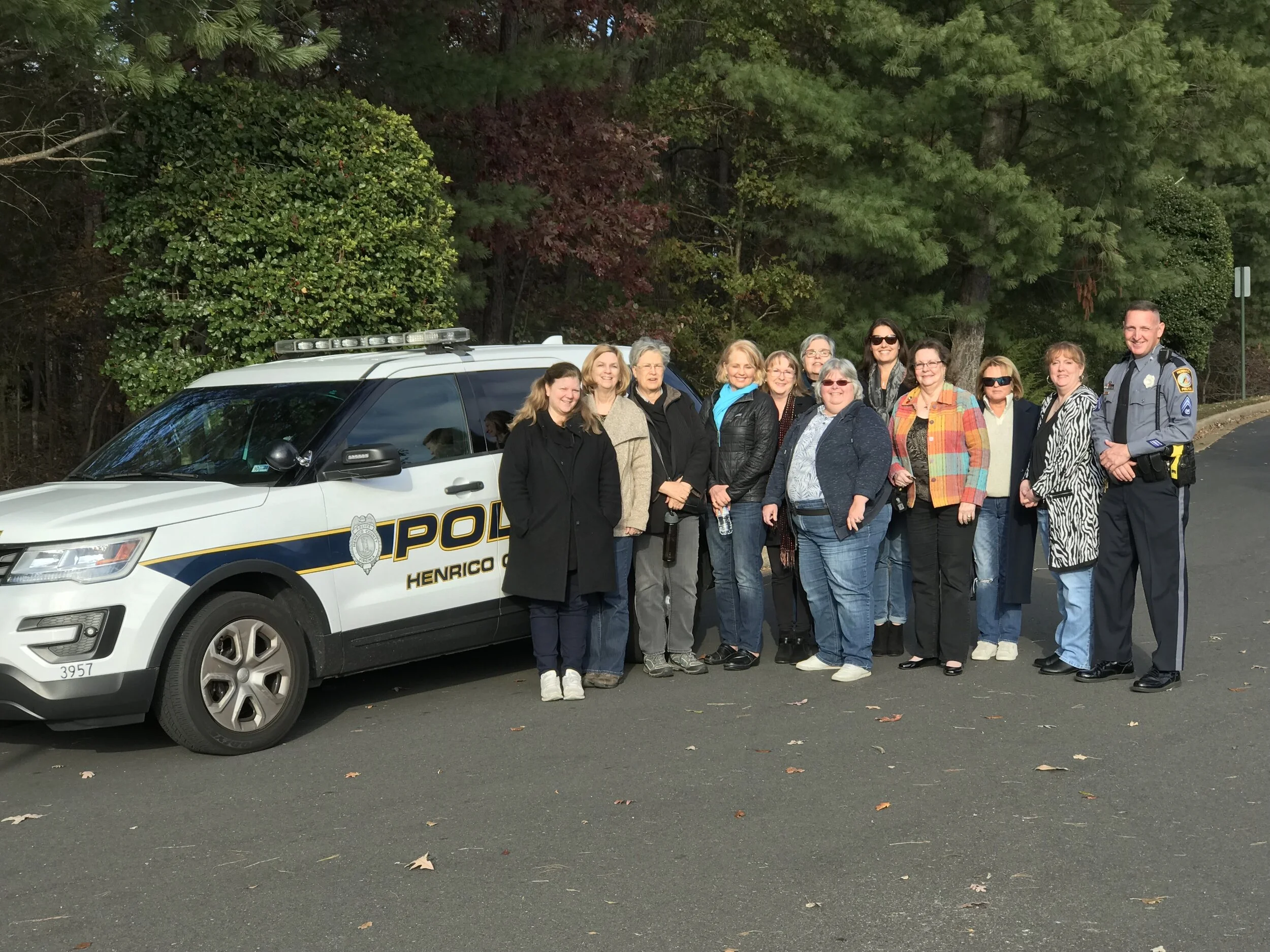
My Sisters in Crime - Central Virginia chapter held a program recently on forensics for the mystery writer called “What Hollywood Gets Wrong.” Many thanks to Officer Richard Mallory and the Henrico Police Department for a great discussion and equipment demo in the parking lot. Here’s what I learned…

faro.png
  1. As a police officer, you never know what you’re walking into. It could be a minor call that turns into something much larger.

  2. “Forensic Files” featured episodes on Henrico County, and “Crime 360” had episodes set in Richmond.

  3. You only get one chance to document a crime scene. Photos and diagrams are key. You must be detailed and accurate.

  4. Faro cameras (that look like surveyor’s equipment) can take hundreds of photos from different angles. They also take measurements.

  5. Witnesses often have different recollections, so it’s important to document everything.

  6. Stress changes your perception and your recollection of events.

  7. This department uses two kinds of fingerprinting equipment. One is a black chalky powder. The other is metallic, and the stylus is magnetic.

  8. Forensic science helps law enforcement to eliminate suspects, as well as confirm others.

  9. Technology and forensic science are powerful tools, but the job still requires old fashioned police investigation.

  10. Most radar guns now contain a laser (lidar), and they can be aimed at a specific vehicle.

  11. I didn’t realize how heavy some of the bullet-proof vests were. And I’m thankful that advancements have been made in safety equipment.

  12. Cameras are everywhere these days, especially in new cars like Tesla.

  13. Forensic analysis takes way longer than it does on TV and in movies. On average in Virginia, Toxicology takes 44 days, Trace Evidence takes 51 days, Firearms Analysis takes 73 days, Forensic Biology takes 103 days, Drug Analysis takes 137 days, and Computer forensics could take up to a year.

lidar.png
IMG_E5045.JPG
IMG_5028.JPG

You Can Find Story Ideas Anywhere - Especially the DMV

dmv.png

I’m convinced you can find characters and story ideas anywhere, even the DMV and the Bureau of Vital Statistics. Last week, I decided to go online and prepare my documents to get my Real ID drivers license. I had everything ready, including my online form. How hard could this be? I was ready.

Last Friday, I arrived at the DMV with all my paperwork in a folder at 8:04. There were 67 people already ahead of me in line, and the place had only been open for 4 minutes. I waited 2 hours to get through the triage desk and to customer service. I’m glad I brought 2 books. I finished the first 1.

When it was my turn at the counter, the clerk did a marriage license search because of my name change years ago. She couldn’t find the record. I had the certificate that city/state issued when I got married, but they wouldn’t accept that as an official document even though it had a nice seal at the top from the Commonwealth. I had to drive downtown to the Bureau of Vital Statistics. Thankfully, the guy there found it and provided a copy. That would have been an awkward dinner conversation. “Hey, Honey. Remember when we thought we were married 28 years ago?” No worries. We’re legal.

Then I had to drive back to the county DMV and finish the process. Three hours later. (And the nice DMV clerk let me back in line, so I didn’t have to start over and go through triage again. If she hadn’t, I probably would still be there.) Then I found out I had to wait 7-11 days for my license to arrive in the mail. (It arrived yesterday, so all is well, but the picture is as bad as the last one. It definitely reflects how frazzled I felt. So for the next eight years, I have a souvenir to help me remember the experience.)

People-watching at the DMV and state agencies is amazing. There are so many opportunities for interesting character descriptions and behaviors. I took notes.

  • The security guard who spent most of his time ferrying clipboards back and forth from triage to customer service - He had a strange resemblance to Barney Fife.

  • The woman who was trying to get a drivers license without any ID

  • The older man who kept complaining in line and trying to start divisive political discussions with his neighbors and his quiet wife who shut him down

  • The clerks at the Bureau of Vital Statistics were dedicated to their processes. They used the formal number calling system through the speakers, even though there were only two of us in line.

  • The middle aged couple who spent their entire wait time trying to find the right personalized license plate from the samples in the display case

  • The toddler who entertained us in the seating area. I’ve never head so many verses of “Baby Shark” before.

  • Oh, and DMV gives you a code when you pass through triage. It has a letter and a number, but none of the numbers are in order, so you can’t tell how long your wait is. I think they did that on purpose.

Eavesdropping (I call it doing research) on conversations provides ideas, too.

  • I heard lots of different dialects and accents.

  • I heard about eight-five different reasons why people came to the DMV that morning.

  • I overheard several phone conversations. And now I know what too much about Nancy and her three teens.

  • And I learned most of the words to “Baby Shark.”

The staff at the DMV and the Bureau of Vital Statistics were very helpful, and I appreciate their expertise. So, look for story and character ideas where every you are, especially when you have to wait in line.

baby shark.png


#ThisorThatThursday Author Interview with Thomas Burns

#ThisorThatThursday Logo.png
inisorrtom.JPG

I’d like to welcome author, Thomas Burns, to the blog for #ThisorThatThursday!

A few of your favorite things: I love my wife and kids, cats, dogs, my garden, and Tai chi.

Things you need to throw out: Nothing. You always need it after you throw it out!

Things you need for your writing sessions: Scrivener, the Internet, my PC

Things that hamper your writing: People, phone calls, errands

Things you love about writing: I create people and worlds, and I learn something new every day.

Things you hate about writing: Nothing.

Things you never want to run out of: Coffee, ammo, or enthusiasm.

Things you wish you’d never bought: The Samsung refrigerator in my kitchen.

Favorite foods: Eggplant, chili peppers, sushi.

Things that make you want to gag: Not much. I haven’t tried Icelandic rotten shark, though.

Favorite music or song: Classical music. Wagner is my favorite composer, and the violin is my favorite instrument.

Music that drives you crazy: A few popular songs that you hear on tapes played in public places. I don’t know their names, but I know them when I hear them.

Something you’re really good at: Writing, science, cooking.

Something you’re really bad at: Dancing, fixing things, suffering fools gladly.

Something you wish you could do: Fly a plane.

Something you wish you’d never learned to do: Nothing. Any skill can be useful at some time.

Things you always put in your books: Love, honor, family,

Things you never put in your books: I’ll put anything necessary to the story, even if it’s distasteful. I even killed the cat once.

Favorite places you’ve been: France, Ireland, New York City.

Places you never want to go to again: Catholic school.

Favorite books (or genre): Atlas Shrugged, Moby Dick, Sherlock Holmes

Books you wouldn’t buy: I’ll read just about anything.

Favorite things to do: Read, write, eat.

Things you’d run through a fire or eat bugs to get out of doing: Talking to people in the morning before I’ve had my coffee, meetings, arguing with an idiot

The nicest thing a reader said to you: Readers talk to you?

The craziest thing a reader said to you: See above.

About Thomas:

Thomas A. Burns, Jr. is the author of the Natalie McMasters Mysteries. He was born and grew up in New Jersey, attended Xavier High School in Manhattan, earned B.S degrees in Zoology and Microbiology at Michigan State University and a M.S. in Microbiology at North Carolina State University. He currently resides in Wendell, North Carolina. As a kid, Tom started reading mysteries with the Hardy Boys, Ken Holt and Rick Brant, and graduated to the classic stories by authors such as A. Conan Doyle, Dorothy Sayers, John Dickson Carr, Erle Stanley Gardner and Rex Stout, to name a few. Tom has written fiction as a hobby all of his life, starting with Man from U.N.C.L.E. stories in marble-backed copybooks in grade school. He built a career as technical, science and medical writer and editor for nearly thirty years in industry and government. Now that he's truly on his own as a novelist, he's excited to publish his own mystery series, as well as to contribute stories about his second most favorite detective to the MX Books of New Sherlock Holmes Stories.

 Let’s Be Social:

Website: https://www.3mdetectiveagency.com/

Facebook: https://www.facebook.com/groups/541595279667727/

Twitter: https://twitter.com/3Mdetective

Instagram: https://www.instagram.com/3mdetective/?hl=en

Tumblr: https://nataliemcmasters.tumblr.com/

Goodreads: https://www.goodreads.com/author/show/17956517.Thomas_A_Burns_Jr_

BookBub: https://www.bookbub.com/profile/thomas-a-burns-jr

stripper_audio_cvr_3_small.png

Editors, Formatters, Proofreaders, Cover Designers, Oh My!

for hire.png

There are times when authors need to hire others like editors, formatters, proofreaders, cover designers, publicists, personal assistants, web designers, social media managers, and photographers to help with book projects. Here are some things I’ve learned through the years.

  1. Your writing is a business. If you are hiring someone to do a job or provide a service, make sure you have a contract, statement of work, or a quote.

  2. Agree on the price up front. Ask to be notified in advance if there are additional charges.

  3. If someone is performing a regular service for you, make sure you agree on the price, the hours, fees, and the billing cycle. You don’t want surprises when the bill comes.

  4. If you’re providing requirements or specifications, ensure that your communications are clear. Many designers will provide two or three rounds of changes, and then there are fees if you have other changes.

  5. Make sure that you agree ahead of time on deadlines.

  6. Keep notes or copies of emails about discussions and agreements. After we talk or have a conference, I always send an email confirming what we agreed to.

  7. Make sure to keep all receipts for your accounting and tax records.

  8. Keep the contact information in a place where you can find it. If you’re doing all work by email, make sure you have a phone number or mailing address information in case you need it.

  9. If you're working with a photographer for professional headshots, ask about how they can be used. Some require specific acknowledgement of copyright.

  10. When I’m going to work with someone new, I always ask around for recommendations and check references.

I depend on a whole group of professionals and their talents to help me with my books and book marketing. It feels daunting at first to find the right people, but when you do, you build up a network of skilled resources that is invaluable.

What else would you add to my list?

Revision Tips for Writers

My Editing Assistant, Disney

My Editing Assistant, Disney

Every author has a different process or style for writing, revising, editing, and proofreading. You need to find what works for you. Try a technique, and if it doesn’t match your style, do something else. Here’s how I do it.

Writing Drafts 1-6-ish

  1. I try to write every day, but sometimes life gets in the way. Do the best you can, but don’t beat yourself up. I find if I skip too many days, I lose my momentum and train of thought. I have to go over my outline again and read what I wrote recently.

  2. I do write down my word count totals at the end of each session to keep track of my progress.

  3. I start plotting on my big white board. Then, I create a Word document with a few sentences for each chapter. I color code clues, romantic elements, and humor. This helps me see visually where things fall in the story. I update the outline as the story changes. I also use this later to help me with my synopsis.

  4. I start writing. I usually type directly into my computer, but sometimes, I do handwrite chapters.

  5. I make sure that I start the book in the template that my agent prefers, so I don’t have to reformat later. This makes the cover page, chapter headings, indents, and footers consistent.

  6. After I have a few chapters, I print the draft and do a quick reread. I make changes, and then I return to writing.

  7. I repeat this for multiple drafts of the book.

  8. I also keep a master character list for each book in the series. It has basic facts and what books the character or location appears in. I use this as I’m writing to make sure I don’t repeat character names and that I keep the facts straight.

  9. When I think I’m done, I print out the whole WIP (Work in Progress) and do some editing and proofreading. My friend, Mary Burton, calls this the “sloppy copy. I break out the red (or pink or purple) pen and look for plot holes and typos.

Revision

  1. I run a spell/grammar check to look for typos.

  2. I keep a list of crutch words (overused words) or ones that should be consistent through out the book. My editor has a list, I have one, and so does my agent. I keep adding to my list. I use the find/replace feature in Word to hunt out the problem words and remove them.

  3. When I think I’m done with the draft (I’m really not), I send it to an editor that I pay to do her magic. When I get her feedback, I update the WIP and print it again. I do another reread to look for any boo boos I made while making changes.

  4. Then I submit it to my critique group. Sometimes, I do this before the independent editor. It just depends on the timing and what projects are going. My group reads 50 pages a month and provides feedback. I make any changes to my WIP and then print another copy and check for typos.

  5. I have a small group of beta readers that I send the entire manuscript to for feedback. They read the book like a reader would and provide suggestions and changes.

  6. I then send it to my agent who is also a great editor/proofreader. Your publisher will also have editors and/or proofreaders. (There are multiple rounds to the revision process.)

  7. I make sure to print a copy of the manuscript after each major revision to ensure that I catch any issues I created while making changes.

When the ARCs Arrive

  1. When you get through all the changes, the book will be formatted, and the publisher usually sends a draft or an ARC (Advance Review Copy) for review. Read it carefully. This is usually your last chance to change anything.

  2. Check everything on the front and back covers.

  3. Check all of the headers and footers.

  4. Check the chapter numbering.

  5. Read the book again.

It is such a good feeling to type “The End,” but it really isn’t. The work begins with the revision part.

Riley providing feedback

Riley providing feedback

#ThisorThatThursday Author Interview with Debra H. Goldstein

#ThisorThatThursday Logo.png
Debra H. Goldstein Headshot.jpg

I would like to welcome author, Debra H. Goldstein, to the blog for #ThisorThatThursday.

A few of your favorite things: I like dark chocolate, quiet time to read, and hanging with family and friends.

Things you need to throw out: Three dressy dresses I bought six years and twenty less pounds ago.

Things you need for your writing sessions: A comfortable chair and show music blaring.

Things that hamper your writing: My husband, who recently retired, being home during my writing time – he keeps the TV louder than my show music.

Things you love about writing: I love the creative process.

Things you hate about writing: I hate the creative process.

Hardest thing about being a writer: The hardest thing is not letting distractions keep me from sitting and writing.
Easiest thing about being a writer: Coming up with ideas.

Favorite foods: I love pizza, ice cream, and dark chocolate.

Things that make you want to gag: Cottage cheese and tuna fish.

Favorite music or song: Show tunes – I love Broadway shows.

Music that drives you crazy: Heavy metal music drives me crazy.

Favorite beverage: Coca-cola
Something that gives you a sour face: Water

 Favorite smell: The fragrance of roses (especially yellow ones simply because I like the look of them)
Something that makes you hold your nose: My husband’s gym clothing after he’s exercised.

The last thing you ordered online: A copy of Damned if you Do Damned if you Don’t by Marjorie K. Osterman

The last thing you regret buying: a hand scale from Magellan’s to weigh luggage

Things you always put in your books: Humor
Things you never put in your books: My family

Favorite places you’ve been: Barcelona, San Francisco, and New York
Places you never want to go to again: Underground in a coal mine where the seam is only three feet high.

Favorite things to do: Spending time with family and friends; going out to eat; reading; and writing.

Things you’d run through a fire or eat bugs to get out of doing: Cooking --- my Sarah Blair character comes by her fear of cooking from scratch naturally

About Debra:

Judge Debra H. Goldstein writes Kensington’s Sarah Blair mystery series (One Taste Too Many, Two Bites Too Many). She also wrote Should Have Played Poker and IPPY Award winning Maze in Blue. Her short stories, including Anthony and Agatha nominated “The Night They Burned Ms. Dixie’s Place,” have appeared in numerous periodicals and anthologies including Alfred Hitchcock Mystery Magazine, Black Cat Mystery Magazine, and Mystery Weekly. Debra serves on the national boards of Sisters in Crime and Mystery Writers of America and is president of the Southeast Chapter of MWA and past president of SinC’s Guppy Chapter. Find out more about Debra at www.DebraHGoldstein.com .

Two Bites Too Many[7878].jpg