Low Cost/No Cost Book Promo Ideas

Low Cost_No Cost (1).png

Writers are always looking for ways to promote their books. You need ways to create a buzz about your book. Here's my list of some low cost/no cost ideas.

Newsletter Swap - Find another author who has a newsletter and readers similar to yours. You create a newsletter that she sends out, and then you do the same for her. Each group of readers get introduced to a new writer.

Facebook Takeover - Find an author who will let you take over her Facebook site for a promotion. Promote the event. Then on the day of the takeover, chat with readers and offer small give aways. Usually, these are done for several hours. 

Guest Blog - Find other authors/book bloggers who will let you do a guest post or an interview on their site. (Our blog, Pens, Paws, and Claws does author interviews on Wednesdays. I'm currently recruiting for spaces for the summer of 2018. Let me know if you're interested. This blog is about writers and their pets.)

Twitter Party/Chat - Host a Twitter Party or Chat. It's usually better if you can recruit several authors to help. Talk about your books and writing and have small give aways.

Facebook Party - Host a Facebook Party on your author site. Talk about your writing projects, chat with readers, and do some contents/give aways. It's usually better to start a new post for each different topic. 

Facebook Hop - This is a scheduled event (usually over several days). When you organize one, you recruit authors who will participate and give away a prize. The organizer lines up all the participants, provides the promotional information, and the links. Each stop on the hop is linked to the next one. (All links have to work, or the hop stops.) It takes a little bit of time and energy (and patience) to organize one, but it's a way for all the authors to gain new readers and followers. (I have a blog post on how to host one if you're interested.) 

What else would you add to my list? Best wishes with your writing and book promotions!
 

Logoverysmall.png

Ways to Promote Your Author Blog

blog.png

A blog is a part of an author's platform. It's a great tool for networking, promoting, and sharing ideas and your work. I have this blog on my website, and I post about writing and books. I am also part of two group blogs, the Lethal Ladies Writes and Pens, Paws, and Claws.The group blogs allow the participants to share the load of content creation and marketing. 

Here's why it's important for authors to build their platform and post regularly.
 

  1. It is best to have your blog on your website. And a blog is a great way to keep your web content fresh. People usually don't revisit sites with old or stale information.
  2. You need a regular blog schedule, My work, writing, and life calendars are jam packed, so I blog weekly (on Fridays). With group blogs, you blog on your assigned day or rotation. For Pens, Paws, and Claws, there are ten of us, we blog every ten weeks. It's best if you can keep a schedule. 
  3. Group blogs are a great way to share the love (and the work). Lethal Ladies Write is made up of members of my local Sisters in Crime chapter here in Central Virginia. Pens, Paws, and Claws are all writers who love animals. We're from all over the US and Canada. Most of us are mysteryand thriller writers, but we also have those who specialize in paranormal, romantic suspense, and YA. I like the mix. We all love our pets, and I'm honored to blog with so many talented writers.
  4. A blog is also platform to promote others. The ten authors blog on Saturdays for Pens, Paws, and Claws. Recently, I added #WriterWednesday. It's a chance for us to interview and showcase other authors. (I put out the call that we were doing interviews, and I'm booked up through June of next year.)
  5. Make your content relevant and useful. Share information (e.g. product reviews, book reviews, services, how to's, great stories, etc.) It shouldn't always be "buy my book."
  6. You need to get the word out about your blog. I share posts on Twitter, Facebook,  Facebook groups, Yahoo groups, Instagram, Google+, Pinterest, and LinkedIn.
  7. Blog promotion groups are a way to market your posts. I am a member of several online promo groups on Facebook. There are calls for blog or social media shares. Read the rules of each carefully. The requirements vary from group to group. By participating, you agree to share others' works on your social media platform. I've doubled my blog traffic by participating. I prefer groups that don't require that you follow or share all posts. I like to read them and choose ones that my readers would be interested in. I've learned a lot and met many talented bloggers and writers.
  8. Make sure that you linkyour blog feed to Goodreads and your Amazon author page. This is a way for readers to find out what you post.
  9. Make sure to put a link to your website or blog in your signature of your email. You'd be surprised at how many people will stop by to check it out.
  10. I also put my website/blog on my business cards, bookmarks, pens, and pencils that I give out at book events.
Logoverysmall.png

What I Learned about "Stepping up to the Stage" from Joan Bowling - Public Speaking Tips for Authors

22046419_1969206869988779_8316711948562908902_n.jpg

This week, I attended the James River Writers' Writing Show, "Stepping up to the Stage" with Joan Bowling. She had some great presentation and public speaking tips for authors. Here's what I learned...

  1. Prepare! Prepare! Prepare! Make sure that you're ready for your event. 
  2. Relax! You are more confident when you feel comfortable.
  3. Make the butterflies you feel fly in formation. Get control of your nerves.
  4. Breathing helps. Calm your thoughts.
  5. Nervousness means you care. Use that energy in your presentation.
  6. You need to create an impression or mood with what you're going to say.
  7. Start off with a question or an "imagine a time when" story. You want to draw your listeners in.
  8. Practice your opening. 
  9. You want your presentation to be an easy conversation. She said to avoid the "wind up." "Hi. Thank you for having me here. I am so honored to be here..."
  10. Know your audience and have questions prepared.
  11. Listening is crucial. 
  12. Be present.
  13. If you're on a stage, do a sound check. Walk around and get to know the environment before the event. 
  14. If you've not used to using a microphone, practice at home with a hairbrush.
  15. The microphone is an extension of your chin. Hold it below your chin. Your audience needs to see your mouth.
  16. When it doubt, use a microphone. It's hard to sustain a voice loud enough for the audience to hear for 45 minutes.
  17. Mingle with the audience before an event.
  18. When you are on stage, scan the audience. Don't do a windshield wiper thing with your head. Scan in a slow "W" formation, so it looks more natural. 
  19. If you're terrified, look at your audience's foreheads. They can't tell that you're not looking directly at them.
  20. Be hydrated before you speak. Stay away from dairy. 
  21. If you're doing a reading, animate it. Leave them with an emotion. Read a funny, scary, or sad excerpt. 
  22. If you're reading, hold the book so they can see it, but don't cover your face. They shouldn't see the top of your head during the entire reading. 
  23. Some people print out the excerpt and read from the paper. (Just make sure that you have your book on the lectern or table, so they can see the cover.
  24. Know the power of a pause. Pause from time to time to let your audience catch up and to draw them in.
  25. Don't do accents in readings.
  26. Get comfortable with the sound of your voice. Tape yourself and listen.
  27. If you're doing TV, make it a live conversation. 
  28. Always have your book with you.
  29. When you're doing a presentation, don't end on a question. End where YOU want to leave the audience. Leave them with an impression.

Joan had some wonderful advice. Check out her website and her newsletter. These are all great ideas that writers need in their toolbox when they're doing a reading or a presentation. 


What I Learned from Book Marketing 101

IMG_1605.JPG

My Sisters in Crime chapter hosted Book Marketing 101 recently with Mary Burton, Mary Behre, Tina Glasneck, and LynDee Walker. These amazing writers are a wealth of information. Here's what I learned.

  1. It is all about discoverability. You need to make it easier for your readers to find your book in a sea of books. You also need to find the best use of your time and resources while trying to reach the most readers.
  2. NetGalley and Book Funnel are good tools to use to get electronic ARCs (Advance Reader Copies) to your early readers.
  3. Offer street team/early reader group membership to super-fans. You need to keep your team energized.
  4. You own your mailing list. Build your list. Take a clipboard for sign ups to EVERY event.
  5. Facebook parties are a great way to celebrate your publication date. Be aware of the different time zones when you're scheduling yours. 
  6. When you know your publication date, work backwards and create a six-week calendar for promotions.
  7. Newsletter swaps are a good way to cross-promote. Find another author, and you create a newsletter for her list, while she does one for yours. It's a way to get information out to a new audience.
  8. Write your next book. Your back catalog helps sell your current book and vice versa.
  9. Google Mark Dawson. He is a good resource on Facebook marketing.
  10. Make sure you have an author page on Amazon and BookBub.
  11. Readers want an experience. Reach out and talk to your readers. Create an experience for them. They'll come back for another book.
  12. Add a sign up button to your Facebook page for your newsletter.
  13. Book clubs are the new book tour. Add a link to your web page for readers and book clubs. Let them know you'll visit or Skype with book clubs.
  14. PicMonkey and Canva are good tools for creating social media graphics.
  15. Readers love bookmarks. Sign them with a Sharpie if you leave them on a table or at an event. 
  16. Decide what your marketing budget is and where you are going to spend your dollars. have a plan.

These ladies were full of great ideas. There are so many ways to market your book. You need to find what works for you.

Logoverysmall.png


Proof of Alien Life or Just Story Ideas?

aaaa.png

You never know where story ideas will come from. Recently we installed two cameras outside. I have a blind driveway, I've always wanted to be able to see who drives up without having to run upstairs to look out a window or open a door. 

I never really knew what was going on in my front yard. And it's been fun. I like being able to see when packages are dropped off. Here are some other things we've "captured" recently.

I thought we captured proof of alien life when I saw this. I have no idea what this is. The bug looks gigantic on the camera. Hopefully, he and I won't meet. I may send this to the "What's Bugging You" team to see what kind of critter this is.

I'm not sure if this little guy was saying hello or attacking the camera. I'm pretty sure he's not the blue bird of happiness. 

And then there are the deer who eat my azaleas and tulips. They come through about every other night for a visit. 

My private investigator, Delanie Fitzgerald, and her sidekick/computer hacker Duncan Reynolds, use security cameras in their investigations. I'm going to expand the use in the next book and add some of the funny things that they might capture. I'm enjoying the videos from the unexpected in my front yard. And you never know where a story idea will come from...

Happy writing!

Logoverysmall.png

10 Book Marketing Ideas

books.png

I'm working with the final proofreader and the cover designer for my next Delanie Fitzgerald novel. It's slated to launch in November, and I'm really excited to share more of Delanie and Duncan (and Margaret's) antics. I learned a lot about book marketing and publicity with the first book, and I'm working on my plan for this one.

For the first book, I was new to the book marketing world. I'd worked with teams on publicity for anthologies. A lot of that knowledge transferred, but it is a little different when it is your book, and your book alone. 

Here are some ideas...

  1. This time, I'm putting pen to paper and defining my marketing plan. I had lists before, but I think planning out and coordinating my publicity will be more effective.
  2. Spread the word with blogs. I'm coordinating blog tours and guest blog posts again this time. It also helped with getting reviews.
  3. I'm going to put out newsletters this time. I've been collecting email addresses for a while, and I never put together a newsletter. 
  4. I'm going to continue to arrange appearances at book stores, book festivals, and other mystery events. I do quite a few author events throughout the year. I enjoy talking with readers and writers. 
  5. I sent out a few press releases last time. I'm going to coordinate this and expand my contacts.
  6. I always send an update to the "news" section of all my professional organizations and alumni groups. Last time, one college did a feature article on it, and the other purchased it for their library's alumni collection.
  7. I have an active social media presence. I added LinkedIn recently to my routine, and that has generated additional traffic for my blogs. Previously, I posted only my professional or "work" announcements there. 
  8. I'm going to coordinate a cover reveal this time to build up some excitement.
  9. I also plan to do more Goodreads give aways. Last time, that generated some buzz for the book.
  10. My Facebook and other social media boosts were more random last time. I'm going to do better at having a strategy for this book. 

I'm also looking forward to our Sisters in Crime - Central Virginia meeting next week with Mary Burton, LynDee Walker, Tina Glasneck, and Mary Behre. They're going to share their book marketing ideas.

What would you add to the list?

Logotiny.png

Pens, Paws, and Claws

logoborder.png

Our new blog, Pens, Paws, and Claws launches today, and I'm really excited to be blogging with a group of amazing writers: Kristin Kisska, Mollie Cox Bryan, Rosemary Stevens, Maggie King, Jeanne Adams, Judy Penz Sheluk, Sheri Levy, Barb Goffman, and Teresa Inge.

My first post appears today. Please stop by for a visit. I interview Lauren, a teen puppy trainer for Guiding Eyes for the Blind.

Lauren and Wheat.jpg
paw.jpg
Logotiny.png

Collaborating on a Mystery Party Script

DSC_6813.JPG

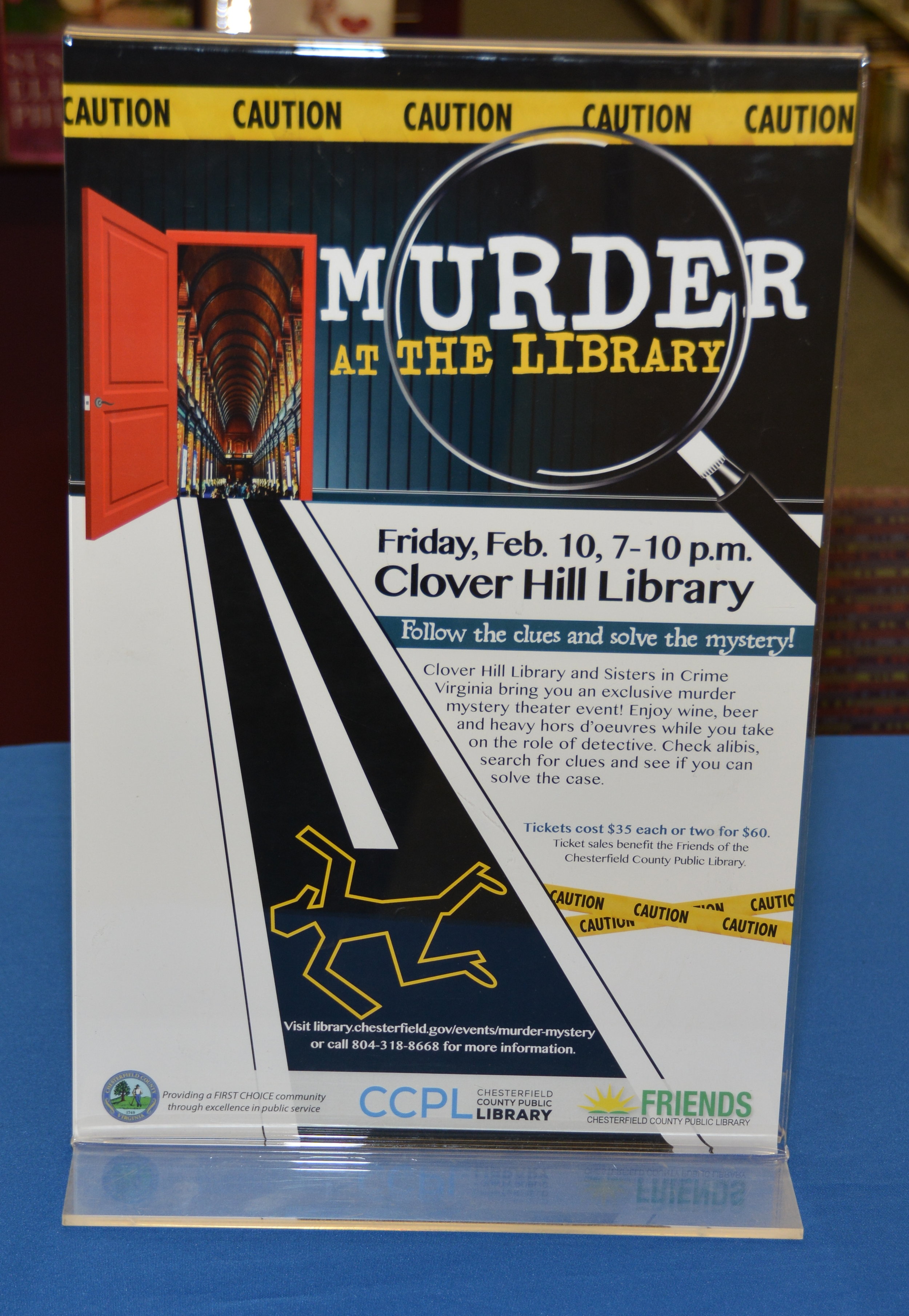
For the past few years, my Sisters in Crime chapter volunteers have been asked to write a script for our library's fundraiser. We write the script, and the very talented librarians and staff bring the play to life. On the night of the event, the guests are divided into two groups. One views the mystery clues, and the other attends an author panel. They switch. Then there's time for the guests to interview the actors and look for clues. Afterwards, there is the big "who dunnit" reveal and a book signing.

The first two years, we killed off the head librarian and the children's librarian. The next event has even more surprises. I met with Mary Miley and Rosemary Shomaker yesterday to create the characters and plot the murder. The collaboration was a lot of fun. Writing is usually a solitary sport, and it was neat to bounce ideas and motives off each other. I just hope the folks in the next booth didn't think we were plotting a real murder.

This event has sold out in the previous years. And it is such a thrill for me to see something we created brought to life. The actors do such a good job of filling out the characters and making the scenario seem realistic. Each guest gets a handout with a list of all the characters and room to make notes. At the end, they vote on who they think the guilty person is.

Here are some things we do to prepare the script.

  1. Work with the library's planning team to get an idea of themes and interests for the event.
  2. Come up with the crime (usually a murder) and build clues around it. It needs to be something that can be done either on or off stage. (The first year, the guests were invited to an event, and they arrived to find the police investigating the head librarian's murder. The next year, the guests were attending a concert by a popular children's musician, and there was a murder.)
  3. Create an interesting/zany cast of characters. Each character needs to have some distinguishing characteristic that the actors can exploit.
  4. Name the characters so that there's not confusion about who did what. You don't want a Kevin, Kyle, and Kurt. 
  5. Think of characteristics or props that the actors can use. The planning team seeds the library with clues and red herrings. 
  6. Make sure that every character has some combination of means, motive, or opportunity. The guilty one should have all three. 
  7. Ensure that there are ways for the audience to get the clues they need (e.g. through action, dialogue, or questioning the suspects). 

I'm looking forward to the next murder mystery evening. I can't wait to see what the actors do with our latest script. 

Logotiny.png
DSC_0188.JPG