Does Your Brand Need Polishing?

As a writer, you are your brand. Every few months, you need to look at your social media presence and make sure that it's polished.

1. Make sure your name is consistent across your sites. If you use pen names, be sure to have a place where you note the other names you use. People need to be able to identify you. It gets confusing if you use different forms of the name (e.g. Tom, Thomas, Tommy, T).

2. Your picture should be similar or the same on your sites. Readers need to be able to recognize that it's you. (I do have different pictures on my personal and author Facebook accounts. It makes it easier to tell which account I'm using to post.) Update your photos every year or two.

3. Your color schemes and artwork should be similar. You need a theme that appears on all of your sites.

4. Check the blurbs that describe you on each site. They should be consistent. Don't overwhelm them with hashtags. Make sure to include your latest book. Update these every few months.

5. Update your email auto-signature to include your social media and web links.

6. Update your content frequently. People don't return to sites where the content never changes. Remove all outdated information. Nobody wants to see a list of your book signings from 2013.

7. Follow the 80/20 rule for content. Eighty percent of your author content should be informational, fun, and conversational. The goal is to build relationships. Only about twenty percent of your content should be "buy my book." Readers tune out noise after a while.

8. When followers comment, retweet, post, or share your content, make sure that you notice and thank them.

9. Check all links on your sites to make sure they're working. If you have a "contact me" section, make sure it works too. You don't want to miss something because of a broken link.

10. Mix up your content. If people follow you on several sites, they don't want to see the same post four times.

Finding and Scheduling Book Signings

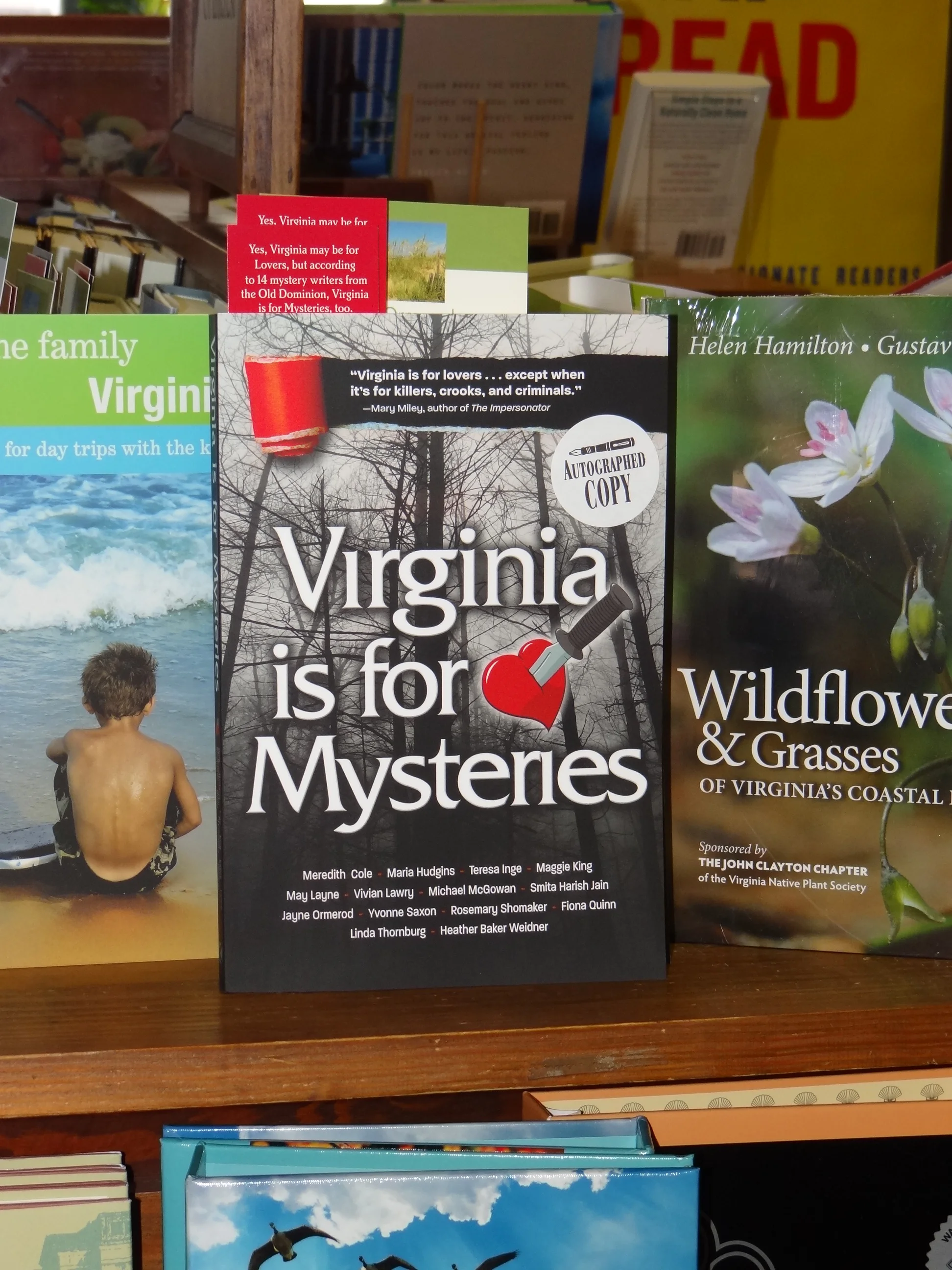
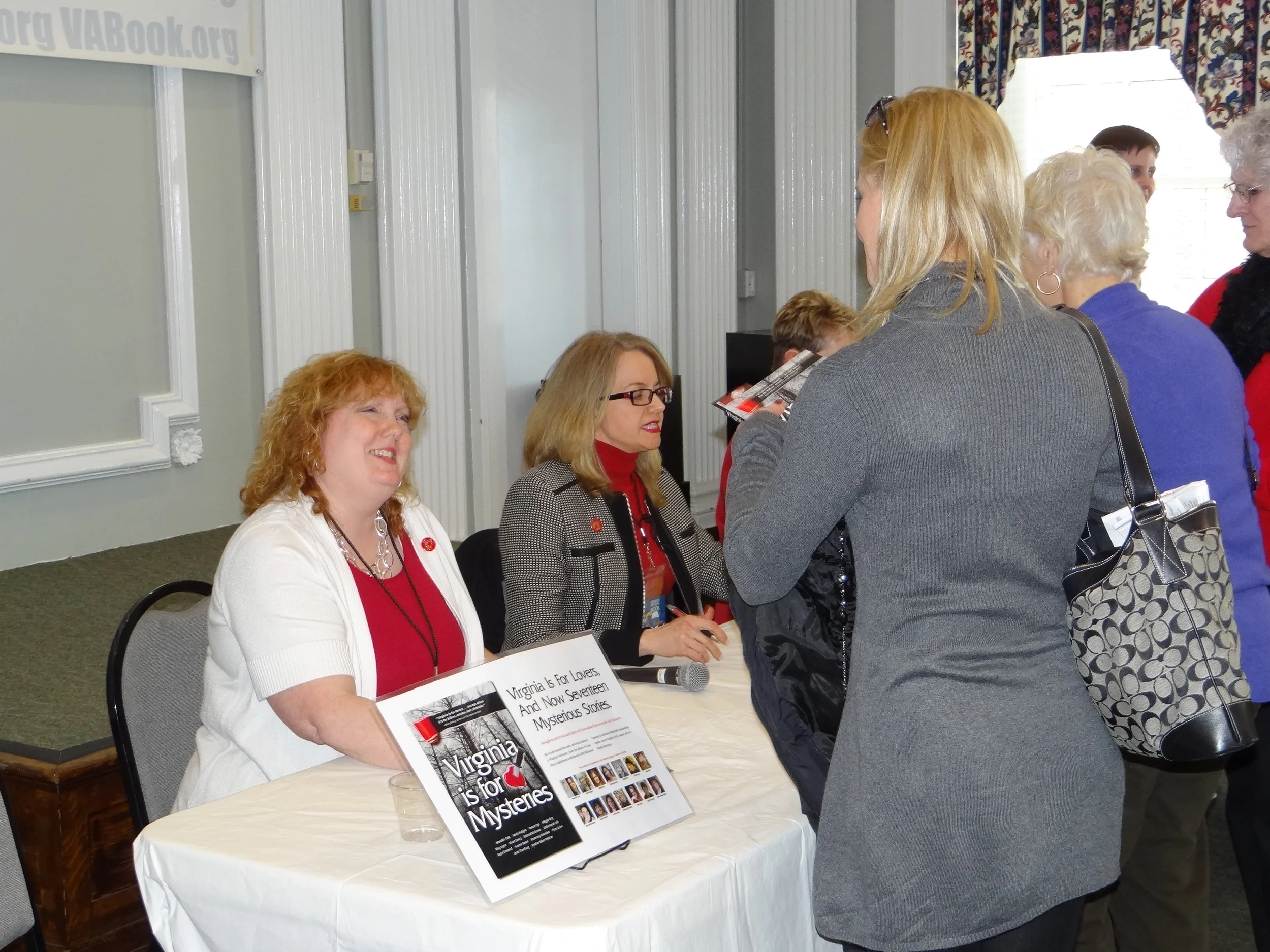
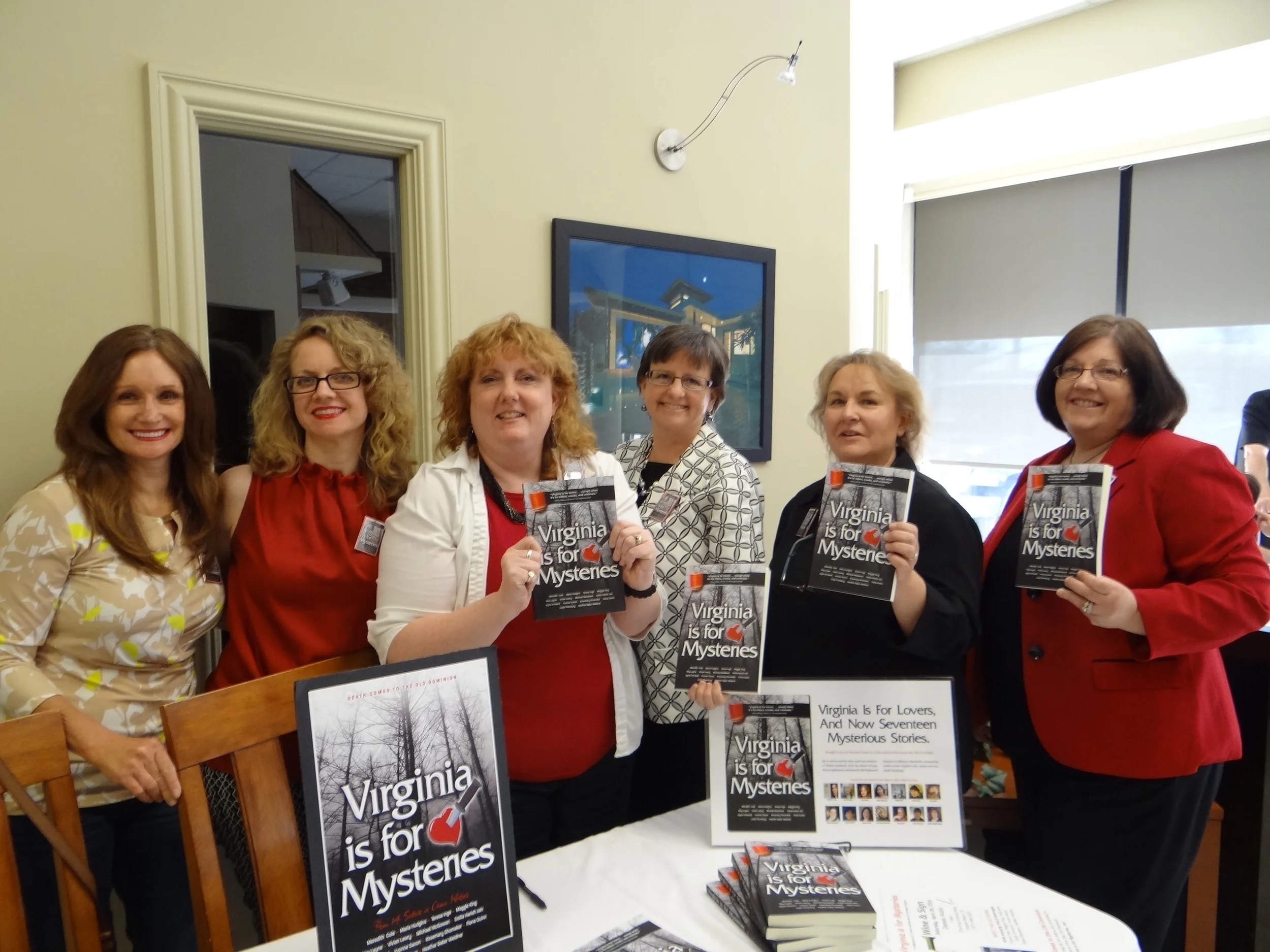
I am part of the team marketing the anthology, Virginia is for Mysteries. Since January 2014, we have had over 43 signings and events and more are scheduled for this summer and fall. We are fortunate that there are 14 authors involved in the project (and 19 for the next version), so we can have lots of signings in lots of places.

Here are some tips for finding and booking signings...

1. Always ask about the logistics when planning an event. I scheduled one in January and didn't think to ask about where we would be sitting. It was outside under a tent. Brrrrrrrr!

2. Many book stores will only order books that can be returned. If yours do not come through a distributor, you may have to ask if the seller will accept books on consignment. It is also a good practice to call the book store a week or so before the event to confirm all details.

3. Have a book signing bag for the event. Bring everything you'll need: pens, book stands, tape, scissors, and bookmarks.

4. Always have candy at your table. Chocolate is a hit.

5. Don't sign by yourself. It can be lonely. Partner with several other authors. With 14 of us, it's a party wherever we go.

6. Always keep a box or two of books in the car. We have sold out at several events.

7. Don't depend on the venue to market the event. If they do, make sure you tweet, share, and post it. You need to send invitations to your fans, friends, and family.

8. Be creative with locations. We have had signings at art galleries, museums, gift shops, libraries, and restaurants. We have also hosted countless panels and workshops for the opportunity to sell books.

9.  Take lots of pictures and post them after the event.

10. Always send a thank you note or email to the host.

11. Every book signing is good. Don't be disappointed if you didn't sell as many books as you wanted. You get to meet people and share what you love to do. (But you do need to be practical. Try venues once. If they don't work, avoid scheduling any follow up events there.)

9 Things I Learned from Critique Group

I am very fortunate to have a wonderful critique group, made up of a variety of talented writers (editors, proofreaders, and readers).  They write novels, short stories, flash fiction, and blogs, but our common theme is the mystery genre.

Here are my top nine bits of wisdom...

1. I learn as much from the discussion of everyone else's work as I do from the discussions about my submission. It's a great place to brainstorm ideas.

2. Whenever I think I am done with a set of drafts, I find I am not. I am too close to it, and I don't see some of the points that others do.

3. Cut the adverbs. Make a list of the words you use too frequently, and use "search" to target them.

4. Cut the fluff. If it doesn't move the action forward, you don't need it.

5. Cut the back story. Avoid huge dumps of information. Sprinkle in what the reader needs to know.

6. There is a difference between having a lot of activity and action in your story. You want the latter.

7. If you're bored with a section in your work, your reader will be too.

8. Critiques are not personal. They are to help you improve your writing. So suck it up, buttercup, and fix the weak points. If you are too sensitive about having your work reviewed, you are going to have a hard time when your readers start making comments.

9. Writing is hard work, and very few people get it right or polished in the first few drafts.

11 Things I Learned about Verbal Judo

George J. Thompson and Jerry B. Jenkins' Verbal Judo: The Gentle Art of Persuasion was originally written for police officers who have to deal with difficult and deadly situations, but its lessons work for all careers, especially writers who encounter their share of criticism. Hey, there's a chapter entitled, "Taking Crap with Dignity...and Style."

Here are my key take-aways for writers/bloggers:

1. Empathy is the "single most powerful concept in the English language" (53).

2. "Your presence and your words when skillfully combined are knowledge and power in action" (93).

3. "Your first goal should be to win the person over" (130).

4. When you deal will difficult situations, apply LEAPS - Listen, Empathize, Ask, Paraphrase, and Summarize (153).

5. "If you disagree with the criticism, hold your tongue for the time being" (178). The authors also recommend that you ignore your inner voice in tense situations because it is usually negative.

6. "Anything decided in the moment will likely be counterproductive" (181). "Use adrenaline; never be ruled by it" (197).

7. "Train yourself to do the opposite of what you feel. If you feel like shouting, whisper" (182).

8. "Always maintain your professional face" (195).

9. "Always treat the other person as you would want to be treated" (195). It's the Golden Rule.

10. "Flexibility requires strength; rigidity equals weakness" (197).

11. "Use positive feedback when you least feel like it" (198).

If you deal with people face-to-face or in the digital world, you'll come across criticism or disputes. Thompson and Jenkins' book offers some good advice and techniques for taking the high road.

Happy reading!

"It's a Great Time to be a Geek!" - Ideas for Writers

I returned this week from the Gartner IT Operations Strategies and Solutions Summit in Orlando, Florida. It's a "Great Time to be a Geek!" Technology is always changing, and there will be exponentially more devices and applications in the next five years that will access the Internet. It's mind-boggling.

Good writers are always looking for ideas - no matter where they are. I came up with a great plot line for my PI series. Here's some of what I learned:

  • There are already smart elevators that use scans to get to your floor, rather than buttons.
  • There are mining operations with computer-driven equipment, including trucks.  The biggest problem they had was with the ruts in the road. All of the trucks took the same path back and forth, and caused a lot of damage. The operators had to program a variety of algorithms to save the mining roads.
  • Ethical reviews are important with technology. For example, should medical devices be blue-tooth-enabled for monitoring? It's a great way for your physician to monitor you, but what happens if it's hacked? Think about the possibilities for legal and medial thrillers.
  • Everything is possible, and nothing is certain. Sounds like a lot of change in the future. As a writer, you do need to be careful when mentioning specific technology unless your work is set in a specific time period. Fax machines and flip phones are out of date.
  • By 2020, over 25 BILLION things will be connected to the Internet. In addition to phones, tablets, and laptops, things like printers, copiers, cars, hospital beds, and refrigerators will be reporting data or communicating to other devices and services.
  • Work is now an activity and not a place. People can work anywhere, anytime.

What I Learned about Funeral Services from Rhonda Pleasants

Rhonda Pleasants, Funeral Director and Professor, spoke recently to our Sisters in Crime - Central Virginia writers' group.

Ms. Pleasants was a wealth of information about embalming, funeral services, religious and historic traditions, and burial services. She answered questions to help the writers get it right. For more information, she recommended The History of American Funeral Directors.

Here's a sample of what I learned:

  • There are "green" burials and "green" cemeteries. The chemicals and burial devices are biodegradable and less chemical.
  • All disinternments in Virginia have to have a permit.
  • The cremation process is more than just an oven. If they have multiple cremations in a day, they usually start with the largest person.
  • Funeral directors need to be familiar with a variety of religions and traditions.
  • Mortuary makeup is like thick, theatrical make up. Makeup is often airbrushed on.
  • They use wax to fill in holes (stab or gunshot wounds) for viewings.
  • Caskets often come with memory drawers and time capsules.
(l-r) Rhonda Pleasants and Rosemary Shomaker

(l-r) Rhonda Pleasants and Rosemary Shomaker