Valuable Lessons Learned from Critique Groups

One of the best things I did early in my career was to find a critique group to help me hone my writing skills and to test out plots. I’ve been in several of all sizes through the years. Some were in person, and others were virtual. Here’s what I learned and what worked for me.

  • I write cozy mysteries, and I focus on groups that are made up of mystery writers. I read mysteries and thrillers, and I understand the conventions. I am able to provide good feedback on others’ work when I know the genre.

  • When I was starting out, my first critique was a mixed group of published and pre-published folks like me. That was helpful. I was in the same boat as the newer writers. The people with more experience had great insights and ideas to share. As the years went by, critique groups come and go for different reasons. My last two groups have been with published mystery writers, and that helps me at this stage in my journey.

  • You will get a lot of feedback and comments about your writing. It took me a while to figure out what changes I should listen to. In the end, it is your work and your voice. If it’s a procedural thing or a plot hole suggestion, then I usually make the change. In my first group, there were fifteen members. When we would go around the table for comments, half would say change something, and then the other half said don’t change it. It was confusing. I finally had to go with the change that would best mesh with where I wanted the story to go.

  • You cannot take the critiques personally. It’s hard. You have worked so long on your manuscript, and now someone is tearing it apart. But my goal was always to improve my work and make it the best it could possibly be. It did take a while to build up a thick skin that I could listen to it and not get my feelings hurt.

  • It helps to set the rules of the group before you start. For my groups, if you see grammar or spelling errors, point them out in your notes, but don’t spend the group time talking about them. Save your comments for plot holes and the craft of writing.

  • Getting a variety of feedback helps me as a writer, and it prepared me for editor, agent, and publisher feedback and reader reviews.

What would you add to my list?
Things New Writers Need to Know

Here’s my list of things new writers need to know (and things I wished I had known when I started.)

  1. Start early. I didn’t think about writing a book until after grad school (and I didn’t get published until my forties).

  2. Find a writing group. You need the support and opportunities that it can provide you. I have met so many amazing and generous people from my writing groups.

  3. Writing is a business, and you have to treat yours like one.

  4. There are a lot of administrative and marketing tasks involved in the life of published authors.

  5. Get serious about your writing and stay focused. Otherwise, you may never finish that book.

  6. Write the first draft. Get it written. Stop revising the first four chapters over and over. You can revise it during the editing stages. (This is why my first book took five years to write.)

  7. Guard your writing time. If you don’t, it will slip it away. I have to treat it as work.

  8. Keep your computers patched and secure. Make sure you have anti-virus software. Back up your files regularly. There is nothing worse than losing a file, especially if it’s your manuscript.

  9. Go through your “how to write” books and keep the ones that speak to you. Give away or sell the others. Sit down and write! (BICFOK - Backside in chair; Fingers on keyboard). I was reading too much about writing and not writing.

  10. Read everything you can get your hands on in your genre.

What would you add to my list?

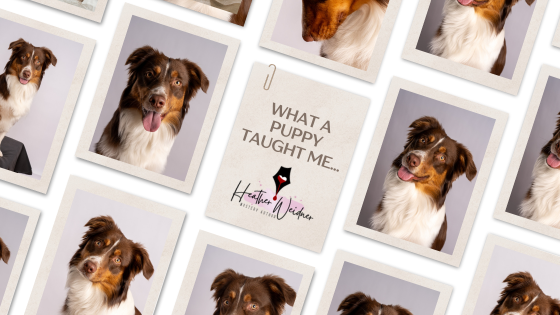
What a Puppy Taught Me...

Last year was rough. We lost both of our beloved Jack Russell Terriers. The Pair of Jacks had lived with us for fifteen years.

When Riley died, we decided to get a puppy, and we brought home a puff ball of a dog, a Mini Aussie Shepherd. We named him Cooper. (He’s our Mini Cooper.) We had forgotten what puppy life was like. We had two Jacks. How much crazier can one puppy be?

Cooper is very active and very bright. But that also means he gets bored easily. We started puppy training early, and it was perfect for teaching good manners and getting him conditioned to being around other dogs and people.

He has such a sweet and loving personality, and he wants to be included in everything.

Here’s what he’s taught me about my writing time.

  1. Take breaks. A quick game of catch or a snack trip can provide the opportunity to move around and not be sedintary.

  2. People and high-energy dogs need exercise. Build time in your schedule. It’ll get the endorphins going and clear your head.

  3. Take a nap or relax when you need it.

  4. Never lose your sense of adventure and fun. Everything is a game to a Mini Aussie.

  5. Also, don’t lose your sense of wonder and curiosity. They’re part of your essence as a writer.

Cooper is always ready to go outside and check out new things. He loves to have fun. He definitely keeps us on our toes and from being all-business all the time. And he’s also willing to be the star of my social posts.

Tell me about any fuzzy, finned, or feathered sidekicks that help you on your writing journey.

What To Do When You Don't Feel Like Writing

When I’m writing a book, I try to write every day. Sometimes, the universe conspires against me, or I just don’t feel sitting in front of screen. It happens. Here are some things you can do instead.

  • Try to have a normal time that you write every day. (Mine is the early morning and my lunch time.) This gets your mind and body into a routine.

  • Guard your writing time. Your time is valuable, and you are pulled in so many different directions. Your research, writing, and marketing time is work. Schedule it if you have to.

  • If you just can’t write, give yourself some grace. Work on other “writing” tasks. Create blog posts. Make marketing graphics. Clean up files or emails. Make sure that your receipts and tax information are updated.

  • I create a tentative schedule when I’m writing a book. My goal is to write 1,000 words on workdays and 3,000 words on weekends/holidays. I try to stick to that to finish my first draft in a reasonable amount of time. Sometimes, I write more to cover for “skip” days or other things I can’t control.

  • Exercise. This will clear your head and give you more energy than you realized.

  • Do some other project you’ve been dreading. There is always a junk drawer or closet that needs cleaning.

  • Work on a craft or make a recipe. These are other creative ways to get your mind working.

What works for you when you don’t feel like sitting down to write?

Spice up Your Mysteries - Just in Time for Valentine's Day

Tomorrow’s Valentine’s Day. I know not everyone celebrates, but I do because it extends the party from my birthday. This year, it’s on Friday the thirteenth, but that’s another story.

So, let’s talk romance. A few years back when I was the program director for our mystery writers’ group, I invited some amazing romance writers to visit and give us some tips for spicing up our mysteries. (Many thanks to Mary Burton, Tracey Livesay, Avery Flynn, and Lisa Dyson for all their great advice!) The writers’ genres variety from sweet to va-va-voom, and it was a hoot to listen to them describe how to write romantic situations.

I write cozy mysteries that are PG-13, so anything too racy happens behind closed doors. That works for cozy mysteries that are primarily based on bringing the guilty to justice and strong character relationships. But, the industry is changing with a whole lot of new subgenres that blend with other book genres like romancy, a combination of fantasy and romance.

In my first series, my character was devoted to her job, and she really didn’t have much of a social life. And I received a lot of feedback from readers that they wanted more romance to make her seem more like a regular person. (Delanie did have a fling in Secret Lives and Private Eyes, and that caused a lot of conflict for the storyline. Later in the series, she starts dating an FBI agent.)

For two of my cozy series, I’m currently writing books 7-9, and I’m toying with the idea of having a wedding. No spoilers yet.

I think romance is important to any story, and here’s why:

  • A little romance livens up the story line.

  • It can create conflict for the characters to move the plot forward (or attempt to derail it).

  • It makes the characters more human. Emotions are a part of life.

  • And romance add some fun elements for the characters and readers.

Do you like a little (or a lot of) romance in your mysteries?

What To Do While You're Waiting...

I never realized how much I would be waiting in my writing life. I am not a patient person. I like websites that respond in three seconds, check-out lines that are short, and quick responses. And I’ve learned, not everyone is on my schedule. There is a lot of waiting when you decide to write or publish a book.

If you want to be traditionally published, there are things you will have wait for. You will wait months (if not years) to hear back about queries, for edits, and for cover designs.

Here are some things you can do while waiting:

  • Write your next book, especially if you are querying your first book. If you get a multiple book offer, you’ll need to have that second book ready for submission in year (or less).

  • Work on your newsletter and social media followings. If you are querying an agent or publisher, they do look at your web presence. After I sold my first book, I spent a lot of the waiting time between edits building up social media followings. It took a lot of time, but it was worth it to build up a base and a small street team.

  • Create or spiff up your website. Make sure it looks like you and your style of writing. Make sure that all of the buttons and links work. The colors, graphics, design, and fonts should be unified.

  • Join a writing group. They are wonderful for networking, finding opportunities, and learning about your craft and genre.

  • Find a critique partner or group to help you polish your manuscript.

Find Your Crew

Lots of studies have been done recently that show the importance of connecting with others. Just Google the topic. There is an overwhelming number that show how we’ve become disconnected in the post-Covid, social media world. Writers need to pay attention to this. You need a team to help you with ideas, celebrations, and support through the bumpy times.

My advice to writers at any stage of their career is to find those people. It may be writing partners, a critique group, a writing organization, or a group chat with other writers. Regardless of whether you are online or in-person, you need to interact regularly with others.

Joining a writing group at the beginning of my journey was the best investment I made. I joined my national and local chapter of Sisters in Crime and James River Writers. I was fortunate that both had in-person as well as online programs.

Writing organizations offer wonderful programs, training, and meet and greet activities. When I had questions about agents, querying, publishers, there was always someone there who was willing to share their time and expertise. I have found critique groups, writing partners, and many many valuable contacts.

I also had my first publishing credit for a short story that was accepted into an anthology. I learned about editing, revising, following guidelines, and submitting work for publication.

The publishing business is like no other, and it is beneficial to be able to talk to people who understand the experience.

No matter what stage of your writing career you’re in, my recommendation is to find a group of writers to share the joy and provide support when there are road bumps.

Writerly, Bookish, and Fun Resources

I subscribe to a lot of newsletters and podcasts, and I want to share some interesting ones with you. These are great for research and ideas.

Newsletters - I love keeping up with authors and what they’re writing, and bookish events. Here are a few that are worth checking out:

Podcasts

What are your favorite newsletters and podcasts?