What I Learned about Crime on Campus

Campus Chiefs of Police Paul Ronka and Dave McCoy spoke at our Sisters in Crime - Central Virginia meeting this week about crime on campus. And yes, someone did ask, "where's the best place to hide a body" on a college campus.

Here's what I learned from both of them. One serves a commuter campus with three locations in Central Virginia, while the other serves a larger private college, where most of the students live on campus.

  • If you're writing a mystery about college life, most incidents happen in the wee hours.
  • While most of what they deal with are parking, stolen items, underage drinking, narcotics, and sexual assaults, their officers are now trained to deal with active shooter or hostage scenarios. They conduct regular training with students and faculty. Life has changed for law enforcement after Columbine. The strategy used to be to set up a perimeter, wait for the SWAT team, and try to engage the shooter in negotiations. Now, the focus is for the first officers on scene to do a tactical entry and locate the shooter.
  • When events occur on campus, their officers are involved with the investigation, but they also involve the local police, state police, FBI, and Homeland Security, as needed.
  • Chief McCoy's campus requires study abroad for many of its students, so he is often called upon to worth with the state department and law enforcement agencies in other countries when incidents or crimes occur involving students from his campus.
  • Both are also responsible for emergency training and drills for earthquakes, hurricanes, and other catastrophic events. They have a variety of tools and alert systems for emergency notifications.
  • After the horrific college campus shootings, colleges in Virginia now have Threat Assessment Teams to evaluate and investigate safety concerns and incidents. These teams determine the best plan of action for the safety of the campus and the students involved.
  • If you're a writer, you need to check out Yik Yak. It's an anonymous site where people (usually college) students in about a mile-radius of your location post comments about all kinds of topics.

Neither officer gave us the "best place to hide a body," but they did talk about maintenance tunnels, steam tunnels, and rooftops. I'm sure there are lots of interesting locations on a college campus...
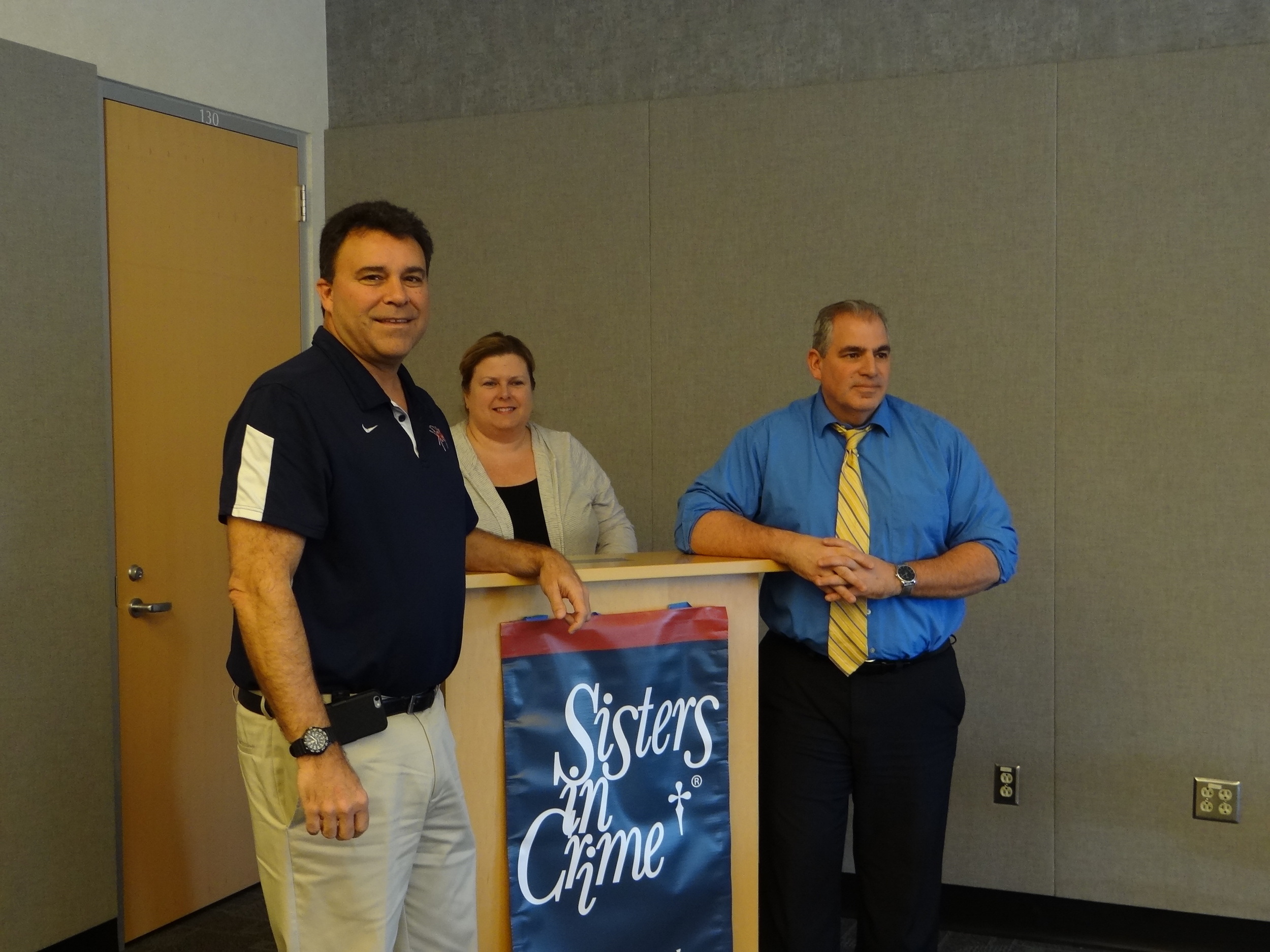
l - r: Dave McCoy, Cynthia Price, and Paul Ronka

A Writer's Checklist

I always have this notion that when I'm done writing a story or manuscript that I'm finished. But in reality, the fun is just starting. There are rounds of reviews and edits to be done. (More than I would like to admit.)

Here's a checklist that I put together of things to look for as I go through the draft reviews.

1. I look at my character names. Make sure that you don't have two or three that start with the same letter or sound. (e.g. Kate, Katie, and Caitlyn or Jones, Johnson, and Jacobs) It can be hard for your readers to keep them straight.

2. Look for repeats in your storytelling and dialogue throughout the entire work. If you're not giving new facts, make sure to remove the duplications.

3. Root our passive sentences. (e.g. The ball was thrown by Jake.) Rewrite these to active voice.

4. Look for overused words. Use your search feature to find and eradicate them. My overused words are just, that, only, and in a few minutes.

5. If you're writing a series, make sure you don't repeat too much from previous books. But you do need to provide some background on characters or big events. We talked about this in critique group this week. We were reading the third book in a series, and a new person asked if the two characters were in a relationship. The rest of the group knew from reading the other works that they were dating, but it wasn't clear to the person who started in the middle of the series.

6. Look at your transitions between paragraphs. Are they smooth? The reader should not get whiplash from any abrupt shifts.

7. Look at the last paragraph of each chapter and make sure readers are compelled to keep reading. Don't give them a reason to drop in their bookmarks.

8. Look through your sentences for "be" verbs. See if you can rewrite these without "was" and "were."

What else would you add to the checklist?

8 Twitter Resources for Writers

Twitter is a powerful tool for driving traffic to your blog or website. There are tons of Twitter resources out there to help you market your site or your book. Here are some sites you need to check out...

Vertical Response Blog - This link offers 12 tips for running a social media contest.

Buffer Social - This describes how to use Twitter's search to return the information you are looking for. There are some neat hacks for customizing your searches to gain analytical insights.

JeffBullas.com - Jeff Bullas' blog has great information for anyone who is using social media for marketing. This post teaches people how to motivate their followers to get them to spread your posts. In this post, he has a great infographic about social media platforms, their users, and the etiquette on each site. And finally, in this post, he shows readers how to improve their graphics or visuals to improve the chances of being shared.

VAGeek.com - This post from Heather Santos offers users ways to get more interactions from their Twitter followers.

RebekahRadice.com - In this post, Rebekah Radice teaches readers how to create the "perfect social media mix."

Inbound Marketing Blog - This post provides "50 Un-boring Ideas" for you to use to improve your content.

Happy New Year, and Happy Writing!

New Year's Resolutions for Writers

It's resolution-making time again. Are you ready for the new year? Here is my list of resolutions for writers...

1. I will make time to write. I will never finish my manuscript if I don't work on it.

2. If I want to be a published author, I need to work on my craft. I will look for ways to improve my writing this year (e.g. classes, critique group, writing partner, etc.).

3. I will invest in my writing business this year. I will create or update my website. I will make sure my social media sites have the same professional look.

4. I will update my headshot. It is noticeable when you're using a ten-year old photo.

5. If I am prepublished, I will send out queries or look for ways to have my work published.

6. I will look at my marketing plan, or I will create one. Where should I spend my time publicizing my blog or my work? How often do I advertise? What platforms work for my type of writing?

7. I will commit to a blog schedule, and I will post regularly.

8. I will strive to be more social on social media platforms. I will share others' information and look for groups with similar interests. I will build relationships and resources.

9. I will strive to balance my writing with all the other things that life throws my way.

10. I will exercise more.

What else would you add? Happy New Year!

Social Media Analytics And Why Numbers are Important to Writers

When you reach certain milestones on Facebook fan pages and other sites, you gain access to analytics, insights, and other metrics. Your website should also have this information. Even if you are not a numbers geek, this data is valuable to you. It shows progress and gaps in your marketing efforts.

While you shouldn't fixate on numbers, followers, retweets, and likes, you should use them as a measure of the post you're creating. Writers also need to remember the social part of social media. You need to build relationships and followers by interacting with each other. If you only use these sites to dump announcements about your reviews and sale items, you're not going to be that successful.

Facebook and Twitter offer a lot of good information. You can see things like which day you get the most traffic. Target those days for posting new material. You can also see which posts get shared or commented on the most. This can help you figure out what type of content works for you. Facebook gives you a lot of information, including the age group/ demographics of your audience. Twitter tells you your reach for the week. You can see which tweets get the most action, and how many lead to link clicks. You should use Twitter and other sites to drive traffic to your blog or website.

If you boosted a post or ran an ad campaign, you can see the results. This can help you decide which types of posts to pay for next time.

Your website should also have metrics you can use to track visitor patterns and what types of content are most popular. I use Bitly to shorten my blog URLs for posting on social media. It has an analytics page that lets me know how many people have clicked on that link and on what days. My website visits were up and down until I committed to post a weekly blog and post links to it on Google+ and Twitter. My Google+ numbers aren't as high as my Twitter ones, but they do help me with my placement in Google searches (SEO).

The charts, graphs, and information can be overwhelming. Start with one item like your reach or the key days of the week. If you need help, Facebook and Google have good help files that explain what the numbers and different charts mean.

All of this information should help you decide what's working for you. If you're scheduling tweets, and you're not getting a lot of retweets, replies, or favorites, then you probably need to look at the content, frequency, and timing of what you do. You're doing a lot of work for not much reward. Also know that if others looks at your recent tweets, they can see the action or inaction too. Mix it up and see if your numbers improve. Make sure to add a couple of relevant hashtags to get the attention of interested readers.

Also note that Facebook changes its algorithms frequently, and this affects what your friends and fans see. I wouldn't depend on it as my only marketing method. To date, I haven't paid to boost any posts, but I'm working on a marketing campaign for my first solo mystery for next spring. I'll let you know how that goes.

Finally, there are way too many social media sites to have an active presence on each. Pick what your readers like and focus your time there. Don't let it overwhelm you. Make small changes and see if your numbers improve.

Happy marketing! And let's connect so we can build our reaches and resources. 

Facebook 

Twitter

numbers.jpg

Why You Need a Critique Group & The Things It's Taught Me...

Nobody writes a perfect first (or third or fourth) draft. And as much as we all like to think what we create is brilliant, we need honest feedback to improve as writers. I absolutely adore my critique group. We meet monthly and turn in about 50 pages for each session. Everyone is a thriller or mystery writer, but the subgenres vary. Our backgrounds vary too, and everyone brings amazing skills and experiences.

I appreciate the feedback, and the monthly deadlines keep me on track with my writing. I learn as much from the conversations about others' work as I do when they review my submissions.

Here's what I learned from last month's meeting...

Backstory - Sprinkle in the history of the story. Don't do a large data dump of character or biographical information. Spread it through your chapters.

Yawn! - If you're bored, your readers will be too.

Chapter Endings - Avoid ending a chapter with a character going to bed. The reader needs a reason to turn the page and not look for a good stopping point.

Crutch Words - Look for words that you overuse. Use your word processor's search feature to find them. Mine are "in a few minutes," "very," and "just." I have a list now, and I search through the draft when I'm self-editing to get rid of them.

Dashing off - If you use dashes, make sure that they're the em dash and not two hyphens.

Semicolons - Watch your use of semicolons. They can be an indicator that your sentences are too long and wordy.

Cut the Fluff - Get rid of useless words and phrases. It makes your writing tighter. Look at your adjectives. You don't need two or three to describe the same thing.

Jump to It - Use "jumps" to indicate the passage of time. You don't have to account for every minute of your character's life. To fly from New York to Paris, you can move from one scene to the next. You don't have to write about driving to the airport, parking, checking in, buying coffee, and sitting in the lounge, unless it's key to the plot of the story.

What's in a Name - Be consistent with what you call your characters. Don't refer to them by multiple names or titles. It confuses your readers.

Best wishes with your writing. Keep at it. It's work, and it takes a lot to revise and rewrite.