Ways Writers Can Use Pinterest

I love Pinterest. It's my big electronic scrapbook for thousands of great pictures. I didn't get interested in the site until I ruptured my Achilles tendon, and I was stuck on the couch for months.

I have boards (the containers you create to group pictures) for crafts, DIY projects, funny memes, recipes, and places I've been or dreamt about.

Writers can use this social media platform to highlight their books.

1. Build a board for your book. Post pictures of what characters would look like, what actors you want to play them in the movie, locations where they visit, and things they like. I have a board for the anthology series that I'm a part of. It's Virginia is for Mysteries, and I have pictures of all the sites mentioned in the stories.

My author friend, Mary Miley, has a board for her 1920s mysteries with all the items from that era.

2. Build boards of your favorite books and authors.

3. Make boards for themes in your book (e.g. pets, historic sites, locales, fashion, foods, knitting, etc.) My writer friend, Mollie Cox Bryan, writes a scrapbooking-themed series. Her Pinterest boards are loaded with ideas and templates.

4. Create boards for your author events and upload photos of signings, panels, and workshops. Make sure to include links in the descriptions when you upload photos.

Let's connect on Pinterest. I can be found at: https://www.pinterest.com/crazyforwords13/


I Have News...

I have a signed contract for the publication of my debut mystery novel, Secret Lives and Private Eyes. It's slated to be published in May 2016. I'm also have a story, "Spring Cleaning," in Virginia is for Mysteries Volume II that comes out in February.

The novel has been years in the making. I stared this about three years ago after burying two other manuscripts in the bottom of my desk drawer.

And now the fun really begins...

Thanksgiving Snuck up on Me...How to Balance Your Writing Life with the Holidays

I have been so busy lately with reviewing ARCs for our anthology (Virginia is for Mysteries Volume II - February 2016), doing the preliminary work for my debut novel, Secret Lives and Private Eyes (May 2016), my day job, preparing to moderate two panels, doing a book signing, and well, just life. I'm still wondering where June went, and Thanksgiving has come and gone.

And now it's time to think about decorating and presents. As a kid, it seemed to take years to get through the year to Christmas. Now, I blink and it's the holiday season again.

My normal day starts at 5 AM, and I'm at work by 7:15. I tend to work 9-10 hour-days and then write and do all the other things that come along. I don't want the holidays to fly by without enjoying them. Here are some ideas to help your writing life stay on track during the craziness that is this time of year...

1. Write blog posts in advance and schedule them. You can schedule Facebook posts and tweets too.

2. Get your holiday shopping and decorating done early. I'm doing a lot of online shopping this year. I hope to be done by the first week in December.

3. I use my TV time to do my social media updates. I also do quick updates in the morning during breakfast.

4. Take a good look at your free time. Are there time sucks? If you cut down on TV, game time, or perusing the Internet, you make free up some chunks of time.

5. I use my lunch hour at work to write and edit. That's five hours a week of extra writing time.

6. I record the shows that I like to watch on TV, so I can speed through the commercials. It does save some time.

7. I have a 35-45-minute daily commute twice a day to work. I listen to a variety of news programs on my satellite radio during the ride, so I don't usually have to catch up on news later. in the evening.

8. Look at your schedule and the activities that you've committed to doing. Are there things you can cut back on or jettison? I had to cut down on some of my volunteer work when I committed to writing.

Holiday wishes and happy writing!


Writers Beware...Things That Annoy Your Readers

My friend, Jayne Ormerod, planted a seed this weekend. She interviewed me recently for her blog, Life's a Beach, and one of her questions was, "What is your pet peeve?" (Mine is people who leave their shopping carts in parking spaces. But that's another story.) It made me think about things that writers do that annoy friends and fans. Here's my list...

1. I know authors need to promote their work, but there is a way to do it without flooding newsfeeds with "Buy My Book" blasts. The 80/20 rule is important in book marketing. You need to share other information too (e.g. fun facts, facts, links, promotions of others, recipes, etc.). People will unfolllow or block you if all your posts are a sales pitch.

2. Then there are the authors who create a great graphic for a launch or book signing that I would like to share, and they've marked it private. Privacy and security are important, but if you're creating an announcement that you want shared, make sure that it's tagged for public access.

3. Again author promotion is important (and often part of your book contract), but don't post your sale, launch, or contest in the comments of someone else's blog or website unless it's part of a discussion, or you're part of the group. I manage several sites for a group of authors and for a book series, and people (not part of our group or even genre) post random, unsolicited announcements about their books being free or on sale.

4. Many people who like a certain genre, follow a lot of groups online. When you do a marketing dump to ten or twelve sites of your latest promotion, it appears on followers' timelines one after the other. If you're going to publish the same thing to multiple sites, schedule them or change up the post.

5. Make sure that your online presence is well-rounded. If all I see from you are announcements about your latest review or your latest 99 cent sale, I get bored. I want to know more about the author. (And you don't have to post personal things.) What research are you doing? What are you writing? What are you reading? What have you learned lately that will help other authors?

6. Other authors aren't your competition. You only need to be better than your last work. It's okay to promote other authors and share their celebrations. Your readers are interested in what you like. You actually have a greater reach if you partner with other writers.

7. If you schedule lots of tweets or Facebook posts, take a minute to see if they're being retweeted/shared. If you're getting a lot with no action, you may want to alter what you're doing. Others looking at your tweets or at you in lists, see a string of posts with no activity or interest. You're spending a lot of time posting content that no one is reading. Try something different. Add hashtags to appeal to specific interests. Add pictures or videos. Concentrate on the type of posts that generate activity for you.

What else would you add to the list? Happy writing and good luck with the marketing!

Riley's helping me with my blog today.

Riley's helping me with my blog today.

Location, Location, Location...The Importance of Setting in Your Work

I attended two panels at Bouchercon 2015 on the importance of setting to your novel, especially your mystery. Donna Andrews moderated "Crime Beyond the White Picket Fence" with her panel, Tom Franklin (who tells the funniest stories about armadillos), Maya Corrigan, LynDee Walker, and Judy Penz Sheluck. Katrina N. Holm's moderated, "Danger and Death in Suburbia,' with Greg Hemen, Mary Sutton, and Lori Roy. Both groups emphasized the importance of where you locate your story. They also focused on smaller communities, rather than large urban areas.

Crime set in small towns are more personal than those committed in the bigger cities. And here's why...

1. In small towns, everyone knows everyone else.

2. Small towns are surrounded by swamps, forests, and farms, all great places to hide a body.

3. Small police forces often don't have quick turn-arounds on forensic investigations. The body often has to be sent to a larger city, and that gives the amateur sleuth some time to figure out the crime before the expert.

4. Murder in a small community is more frightening. Crime destroys the trust of a close-knit group.

5. Suburbia used to be the ultimate goal of the American dream. This changed with the economic downturn, and it's led to the rise of crime outside of the urban areas.

6. The suburbs are often the femme fatal that lure people with the promise of the perfect life.

7. Small towns and suburbs are where the families and the secrets live.

And secrets are always key to a good mystery.

Keeping it Moving - Maintaining Plot

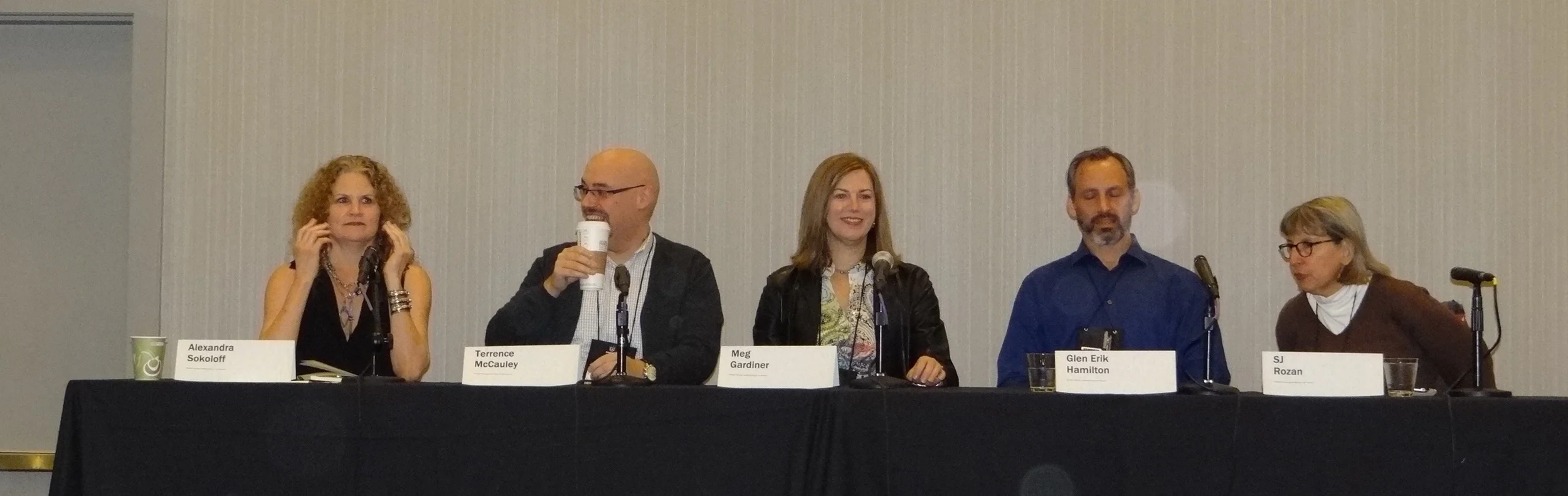
Plot and pacing are key to successful writing. Too much or too little can cause issues. I attended a fun panel on plotting recently. The authors, Meg Gardner, Glen Erik Hamilton, Alexandra Sokoloff, Terrence McCauley, and S.J. Rozan offered tips for keeping your story moving. Here are twelve ideas to help tighten up your writing.

1. Make sure your characters get in trouble in the novel. Conflict always leads to action.

2. Shorter chapters help move the story along.

3. Dialogue is faster to read than dense narrative. Be strategic about where you put your narrative.

4. Sprinkle in the back story. Avoid data dumps of information about your character's history.

5. Build tension in your story and then release it, but don't release it too soon.

6. Avoid ending your chapters with the character going to bed or thinking. If you do, make sure that something interesting happens along with it. You don't want to give readers the idea that your chapter end is a good stopping point. You want your reader to keep reading.

7. Don't let your characters get bored.

8. Read over your work. If you're bored, your readers will be too.

9. Look at how many times your characters eat. Think of something else for them to do.

10. Use jump cuts (moving the story to the next scene) to keep the action in motion. You don't have to tell your readers every detail of each activity. If the character is in New York and goes to Egypt, you don't have to write about every detail of getting on the plane and flying unless it is key to the story.

11. Cut out any unnecessary words. Don't write a paragraph when a sentence will do.

12. Keep your reader engaged.

These are good reminders to make your writing strong and to keep the story flowing. What else would you add to the list?

My Fan Girl Moment...And What I Learned about Writing from Dashiell Hammett's Granddaughter and Biographer

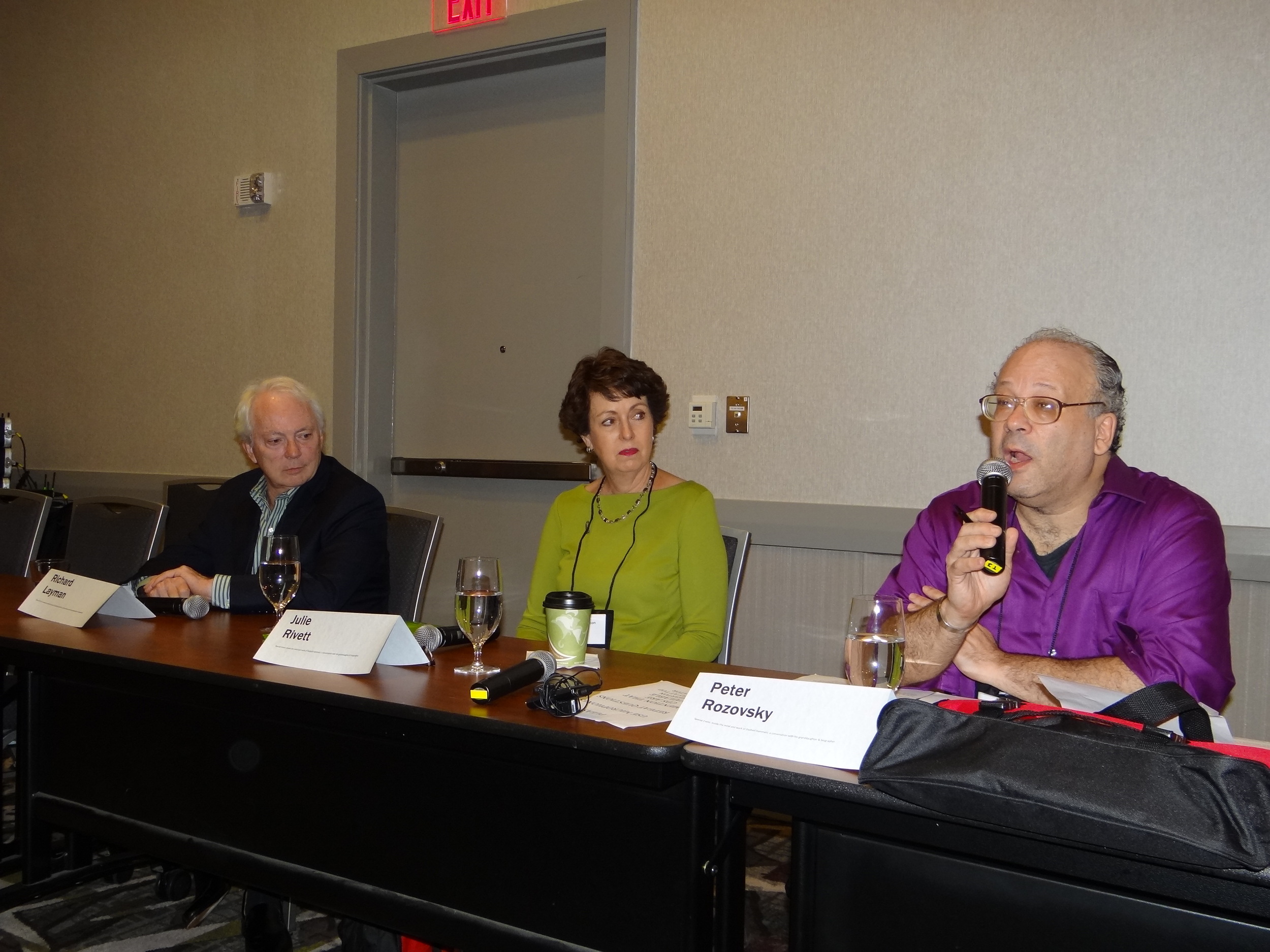
I had the great pleasure of meeting Julie Rivett (Dashiell Hammett's granddaughter) and Richard Layman (a Hammett biographer) recently at Bouchercon. Their talk of on one of my favorite mystery authors was a dream come true for mystery fans. I loved getting the business/historical perspective of his life juxtaposed to the family memories and stories.

Here are some tidbits of interest from their presentation...

1. Dashiell Hammett was a master of dialogue and his novels were cinematically structured. This made an easy transition for him when started writing for the movies.

2. Rivett and Layman have a new electronic book coming out in 2016 of Hammett's short stories. They appear in order of original publication. One story even has the original author's character and plot notes included.

3. Hammett also wrote many stories that weren't in the detective genre.

4. Hammett's writing style was compact and concise, and that influenced the style and genre for novels that came after his.

5. Hammett's philosophy was to get out of the way of the story. He believed that the characters told the story. Good advice for writers.

6. The family donated Hammett's papers and documents to the University of South Carolina. This is a huge opportunity for literary research. And it preserves the legacy of Dashiell Hammett for years to come.


Forensic and Technology Tips for Authors

I had the pleasure of attending a forensic and technology panel at Bouchercon 2015 with Neal Griffin, Kathy Reichs, Anne Hillerman, Ryan Quinn, and Alex Letrau. Here are some of the tips they offered to help writers make their mysteries and thrillers more plausible.

1. Even with all the science and technology, you still need the dogged persistence of a good investigator. Make your detective strong with good instincts.

2. The creation of databases for forensic information has been an extremely effective tool for crime solvers. These vast databases provide samples for comparison for investigators. Without the comparison, the technology isn't viable.

3. Weaponizing contagions is not as easy as it is portrayed on TV and in movies. It is very difficult and expensive, and most portrayals are more fantasy/science fiction rather than reality.

4. If you are writing about the world of espionage, the WikiLeaks, Chelsea Manning, and Edward Snowden information provide a lot of critical details about the spyworld. And all the information is available on the Internet.

5. Make your stories plausible. You need to get the facts right for your readers to believe in your work.

6. Do your research, but you do not need to put every little, scientific detail in your writing. Keep it fun and interesting.

l-r: Ryan Quinn, Anne Hillerman, Alex Letrau, Kathy Reichs, and Neal Griffin

l-r: Ryan Quinn, Anne Hillerman, Alex Letrau, Kathy Reichs, and Neal Griffin