My Fan Girl Moment...And What I Learned about Writing from Dashiell Hammett's Granddaughter and Biographer

I had the great pleasure of meeting Julie Rivett (Dashiell Hammett's granddaughter) and Richard Layman (a Hammett biographer) recently at Bouchercon. Their talk of on one of my favorite mystery authors was a dream come true for mystery fans. I loved getting the business/historical perspective of his life juxtaposed to the family memories and stories.

Here are some tidbits of interest from their presentation...

1. Dashiell Hammett was a master of dialogue and his novels were cinematically structured. This made an easy transition for him when started writing for the movies.

2. Rivett and Layman have a new electronic book coming out in 2016 of Hammett's short stories. They appear in order of original publication. One story even has the original author's character and plot notes included.

3. Hammett also wrote many stories that weren't in the detective genre.

4. Hammett's writing style was compact and concise, and that influenced the style and genre for novels that came after his.

5. Hammett's philosophy was to get out of the way of the story. He believed that the characters told the story. Good advice for writers.

6. The family donated Hammett's papers and documents to the University of South Carolina. This is a huge opportunity for literary research. And it preserves the legacy of Dashiell Hammett for years to come.


Forensic and Technology Tips for Authors

I had the pleasure of attending a forensic and technology panel at Bouchercon 2015 with Neal Griffin, Kathy Reichs, Anne Hillerman, Ryan Quinn, and Alex Letrau. Here are some of the tips they offered to help writers make their mysteries and thrillers more plausible.

1. Even with all the science and technology, you still need the dogged persistence of a good investigator. Make your detective strong with good instincts.

2. The creation of databases for forensic information has been an extremely effective tool for crime solvers. These vast databases provide samples for comparison for investigators. Without the comparison, the technology isn't viable.

3. Weaponizing contagions is not as easy as it is portrayed on TV and in movies. It is very difficult and expensive, and most portrayals are more fantasy/science fiction rather than reality.

4. If you are writing about the world of espionage, the WikiLeaks, Chelsea Manning, and Edward Snowden information provide a lot of critical details about the spyworld. And all the information is available on the Internet.

5. Make your stories plausible. You need to get the facts right for your readers to believe in your work.

6. Do your research, but you do not need to put every little, scientific detail in your writing. Keep it fun and interesting.

l-r: Ryan Quinn, Anne Hillerman, Alex Letrau, Kathy Reichs, and Neal Griffin

l-r: Ryan Quinn, Anne Hillerman, Alex Letrau, Kathy Reichs, and Neal Griffin

9 Things I Learned about Search Dogs and Their Training

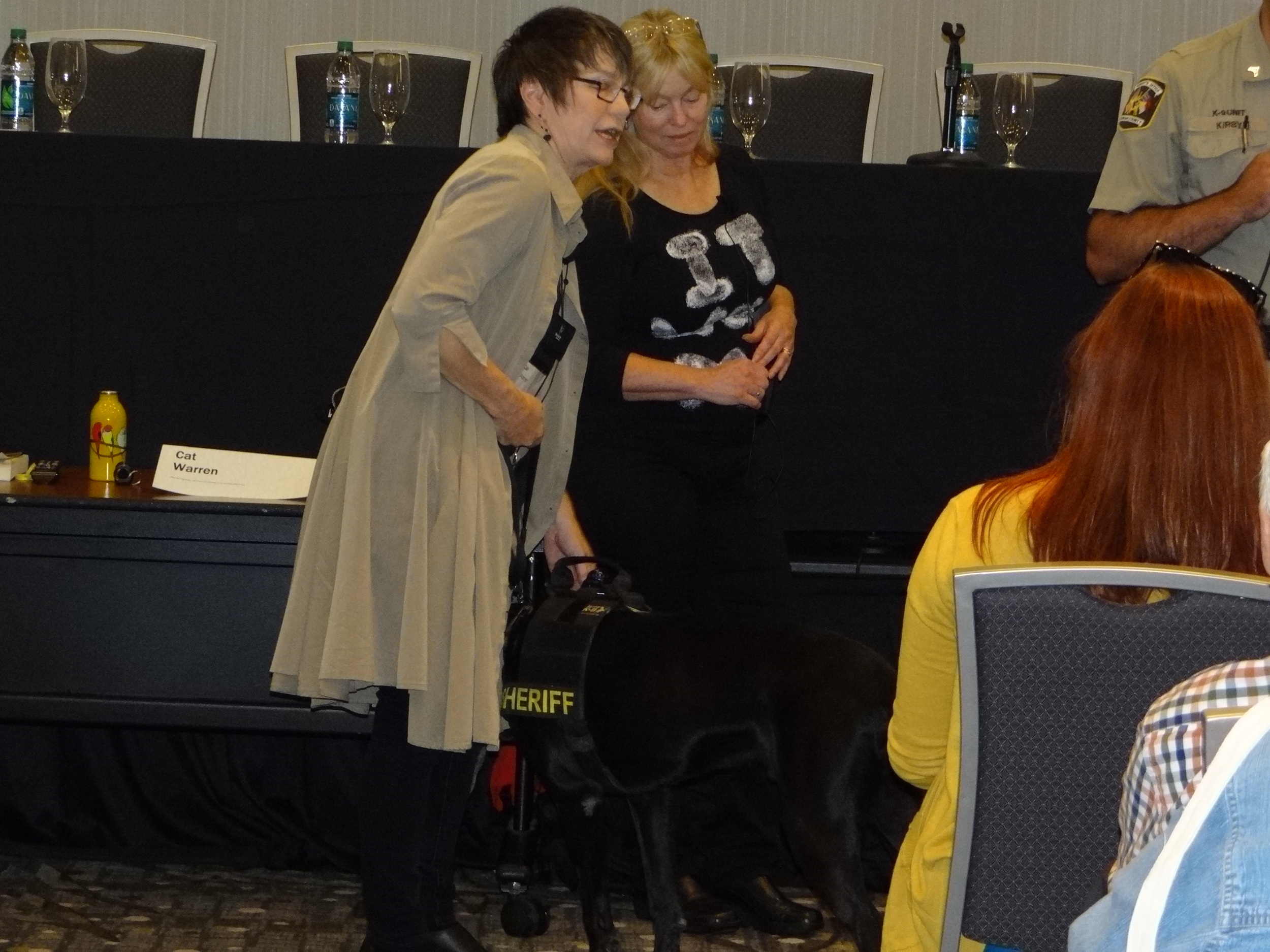
I had the pleasure of attending "What the Dog Knows" at Bouchercon 2015 with Cat Warren, Kate Flora, and representatives from the Durham Sheriff's Office. Cat Warren and Kate Flora are a wealth of information. I love dogs, and it was fun to watch Dreyfus the dog in action.

Here's what I learned...

1. Dogs with energy and drive make the best search dog candidates. Dreyfus is a black Lab.

2. Cadaver dogs can tell the difference between human and animal bones.

3. Many government and police agencies have dogs with training in several areas (search/rescue, cadaver, water rescue, etc.). Dreyfus, from Durham, is trained in cadaver searches and water rescues.

4. The toy/game and the collar/harness clue the dog into the type of work that needs to be done. Dreyfus has a different collar for water rescue than he does for cadaver searches.

5. The scent has to be available for the dog to find it. It often takes two weeks for the scent to rise up from a buried body.

6. These types of searches always require a team. It's usually the handler, dog, and other trained staff.

7. Missing person and searches for human remains are complicated. Searchers can go for days without a lead.

8. Dogs are often used in bedbug searches.

9. Watch the teamwork between the handler and the dog. If you're going to have a search dog in your writing, you need to observe a team in action.

l-r: Cat Warren, Kate Flora, and Dreyfus

l-r: Cat Warren, Kate Flora, and Dreyfus


What I Learned about Social Media from "Tweet This"

I attended Bouchercon 2015 in Raleigh, North Carolina recently. "Tweet This" by Deborah Lacy, Maddee James, Janet Rudolph, Cara Brookins, and DruAnn Love provided some great social media tips for writers. Here's my quick summary of fifteen key points.

1. You don't have to do all platforms. You will get overwhelmed and frustrated if you try.

2. Know the target audience of the platform you choose. The demographics will help you decide if its the same audience for the type of books you write.

3. Social media is about building relationships.

4. All of your posts and tweets shouldn't be "buy my book."

5. Have fun. Don't take yourself too seriously.

6. Make your posts easy to share.

7. Use hashtags. If your audience is over 35, limit your hashtags to two. If your target audience is younger, don't worry about the number of hashtags.

8. Don't put the exact same information on all your platforms at the same time. Mix it up. Fans don't want to read the same post on four different sites.

9. Pinterest has a lot of options for authors. People like to see pictures of what you're writing about.

10. Don't forget to post videos from time to time.

11. Band together with other writers to promote each others' work. Your reach grows with each share.

12. Have discussions. Network and interact with people.

13. Share interesting things (e.g. hobbies, funny pictures, hints, and pictures). People love dog and cat pictures.

14. Build your brand on all your platforms. Your book covers should be on all your banners.

15. Social media can be a "weapon of mass distraction" (Cara Brookins' term). Don't get sucked into spending too much time online.

Social media sites are powerful (and low cost) marketing tools for authors. Step in and try them. Start small and build your networks.

In a Rut? Ten Ways to Recharge Your Writing

Every once in a while, I get too comfortable in my routine or life is just crazy, and I don't feel very creative or I take a break from writing. Here's my list of ten things to do to give you a jumpstart.

1. Mix it up. Vary your routine. Change the setting on your shower. Wear something you won't normally be seen in. Try a different route to work or eat something out of the ordinary. Have breakfast for dinner to shake up the routine.

2. Try a different hair style. Change your makeup or paint your nails.

3. Journal or do stream of consciousness writing. Sit down and just write. Nothing is off limits. Don't edit or proofread. Just write. You may be surprised at the results.

4. Find a book or website with writing prompts. Do one or two to get you started. They may turn into an interesting blog post.

5. Do a project. Try a new recipe, paint, sew, refinish furniture, make a scrapbook, or knit a scarf. Creativity expression comes in thousands of different forms.

6. Exercise or go for a walk. It'll clear your head and change your perspective.

7. Visit somewhere different. Take a vacation, go to a museum, or visit your city. The time away is a good break.

8. Learn something new. Take a class, watch a YouTube how-to video. There are plenty of free or online classes.

9. Volunteer. Donate some time to a worthwhile cause and meet some new people with different experiences. You'll get as much as you give.

10. Go for a drive. I commute about two hours a day, and I do my best plotting in the car.

What else would you add to the list?

What I Learned from Publicist, Joan Schulhafer

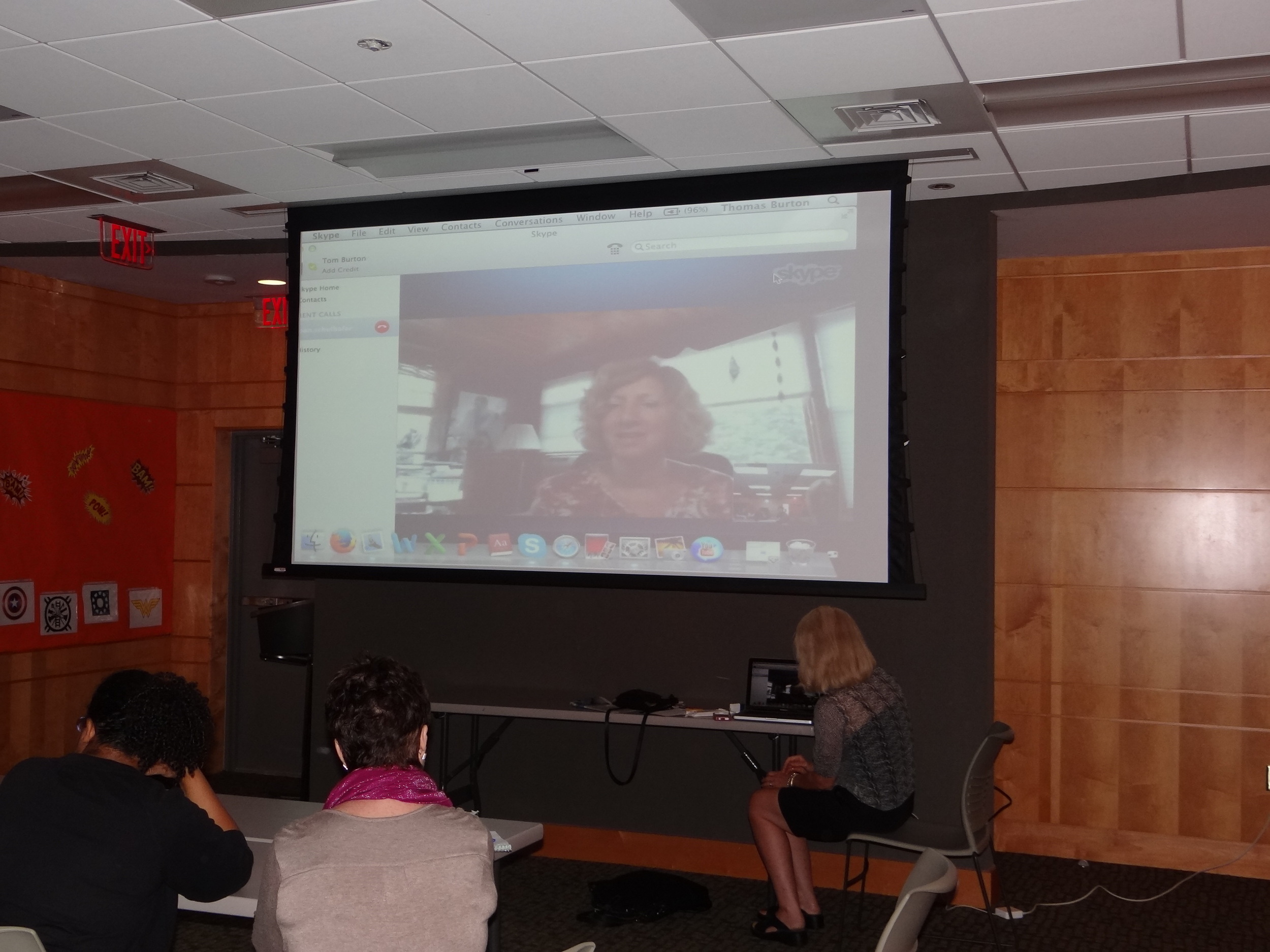
Joan Schulhafer skyped with our Sisters in Crime - Central Virginia chapter recently and provided great information about publicizing yourself as a writer and your book. Here are nine things I learned from her presentation:

1. Authors need to balance their online and in-person presences. You need a mix of both.

2. You can't do everything, but get out and get involved.

3. Attend conferences and network with everyone.

4. Build your email list. It's valuable for authors.

5. Blogging is important. It's a way to keep your website fresh. Blog posts do not have to be deep, witty, or perfect.

6. Pictures are important. Take lots of pictures. Post pictures with your content.

7. Make sure that your biographies and other information are current on all the social media sites where you have accounts.

8. Authors needs to be on Facebook, Twitter, YouTube, Google+, Instagram, and Pinterest. If your readers are younger, you need to be on Snap Chat.

9. Be polite on social media. Don't forget to thank those who help you.


What's Your Social Media Strategy?

You are your brand. Your author presence on social media should have a strategy, plan, and purpose. You want a unified look.

Drive Traffic to Your Blog or Website - One of your primary goals should be to drive traffic to your blog or website. Tweet links of your blog posts (new and recycled). Schedule them with a tool like TweetDeck or Hootsuite to post during hours you don't normally tweet. I schedule tweets at night or while I'm at work, and I've picked up new readers from different time zones. Schedule sparingly though. If someone follows you on different sites or views lists, you don't want hourly tweets of the same thing.

Analyze Your Content - Look at your posts and tweets. Are you getting likes, favorites, retweets, and shares? If not, consider rewriting your content. Make sure that you include videos or pictures. Also use hashtags (no more than two) to get noticed by like-minded readers.

Diversity is Key - Make sure your social media use focuses on the "social" part. You should join conversations, share others' materials, and thank those who share your stuff. People tend toignore you if all your posts are "buy my book." If you use hashtags regularly, make sure that you share others' postings from that list. You don't want to be a lurker.

Use Analytics - Facebook, Google, your website, and other sites have analytics. There is a lot of good information there about who's coming to your site and when. If you notice you have higher traffic on certain days, plan your posts then. Likes, shares, and retweets expand your reach.

Learn What Your Readers Use - Use the social media sites that your readers frequent. I learned this from Rachel Thompson of Bad Redhead Media. Google social media demographics. There is a lot of free information out there. Target your social media platform to what works for your audience. (The majority of Facebook users are women over forty.)

Be Adventurous - Be willing to try new social media sites and techniques. Try it and check your analytics. If it doesn't give you the results you want, modify it or try something else.

Look carefully at all of your social media sites. The colors, look, and writing style should be the same or similar. Themes are good. Your pictures and name should be the same on all sites. Make sure that you cross-pollinate your sites. List your website and blog in all of your biographies. Make sure that all of your links work.

I never knew how much marketing was involved with writing books. Best wishes for your writing and promotional projects!


Does Your Brand Need Polishing?

As a writer, you are your brand. Every few months, you need to look at your social media presence and make sure that it's polished.

1. Make sure your name is consistent across your sites. If you use pen names, be sure to have a place where you note the other names you use. People need to be able to identify you. It gets confusing if you use different forms of the name (e.g. Tom, Thomas, Tommy, T).

2. Your picture should be similar or the same on your sites. Readers need to be able to recognize that it's you. (I do have different pictures on my personal and author Facebook accounts. It makes it easier to tell which account I'm using to post.) Update your photos every year or two.

3. Your color schemes and artwork should be similar. You need a theme that appears on all of your sites.

4. Check the blurbs that describe you on each site. They should be consistent. Don't overwhelm them with hashtags. Make sure to include your latest book. Update these every few months.

5. Update your email auto-signature to include your social media and web links.

6. Update your content frequently. People don't return to sites where the content never changes. Remove all outdated information. Nobody wants to see a list of your book signings from 2013.

7. Follow the 80/20 rule for content. Eighty percent of your author content should be informational, fun, and conversational. The goal is to build relationships. Only about twenty percent of your content should be "buy my book." Readers tune out noise after a while.

8. When followers comment, retweet, post, or share your content, make sure that you notice and thank them.

9. Check all links on your sites to make sure they're working. If you have a "contact me" section, make sure it works too. You don't want to miss something because of a broken link.

10. Mix up your content. If people follow you on several sites, they don't want to see the same post four times.