Professionalism Goes A Long Way...

I thought when I became an author that I would sit at my desk and write one brilliant book after another. I had no idea how much marketing and publicity were involved. Then there are royalties, contracts, tax implications, and sales tax that make your head spin. I quickly learned that as much as I loved books and writing, this was a business, and I needed to treat it as such.

1. Know when to consult lawyers, CPAs, and tax professionals. Make sure you know about your tax bracket, deductions, business licenses, and sales tax rules.

2. Get a professional headshot. It's an investment, but it shows that you are serious about your writing.

3. Get an author website. Make sure that it has your biography, photo, link to your books, and a way to contact you.

4. Be prompt when responding to emails and phone calls. Publishers, publicists, agents, and book store owners expect to be dealing with professionals.

5. Always meet your deadlines and commitments. This goes for volunteer work too.

6. Thank people who help you, provide good reviews, and share your social media.

7. When you contact booksellers, reporters, agents, publishers, etc., be prepared. Make sure you have a polished biography, synopsis, and links to your social media sites.

8. If you're going to create a blog, website, or social media sites, make sure that you post regularly. If the content isn't fresh, visitors won't come back, or they'll drop you.

9. Proofread your stuff. Make sure that your sites, emails, and marketing materials are organized, easy to read, and current. You really only do get one shot at making a first impression.

Best wishes with your writing. It's a lot of work, but it's worth it.


What I Learned from David Casullo about High-Energy Cultures

I read a lot of books on leadership and customer service. David Casullo's Leading the High-Energy Culture is a good reference for new or seasoned managers. But his life lessons also apply to writers. Here's what I learned...

1. "Raise the Bar" should be your rallying cry for yourself and your team.

2. Energize those around you.

3. Communicate clearly and with purpose and passion.

4. Behave consistently with your values and beliefs.

5. Know the lay of the land at your organization and adapt as you need to.

6. A successful leader demonstrates Character, Commitment, Competence, Courage, and Communication.

7. People are fascinated with secrets and mysteries. As a mystery reader and writer, this was my favorite.

8. Focus on face-to-face interactions. Important information should be delivered face-to-face and not through email or texts.

9. Communication is an art and a science.

10. Simple is hard. People don't have time for elaborate explanations. It takes longer to craft your communication for your audience.

11. When people remember your story, they remember the point, and they remember you.


What I Learned from Starbucks and Joseph Michelli

My niece landed a job recently in a Starbucks, and it was interesting to hear about life as a new barista. Coincidentally, I finished Joseph A. Michelli's Leading the Starbucks Way: 5 Principles for Connecting with your Customers, Your Products, and Your People. Check out his website and blog.

1. Love, Humanity, and Humility should be your performance drivers.

2. If you don't have passion for your product or service, why should your customer?

3. Your customer service behaviors should include anticipating, connecting, personalizing, and owning.

4. You need to cherish and challenge your legacy. It's not just today's sale.

Michelli's book focuses on customer service and leadership, but the advice works for writers who are trying to market their work.


Saying Goodbye to an Old Friend...

The City of Virginia Beach is going to tear down the Kempsville Recreation Center in order to build a new one. I'm all for progress, but it's a little bittersweet. It's like losing an old friend.

In the fourth grade, my mom signed my sister and me up for swim lessons in the almost Olympic-sized pool. A tornado or straight winds came through and ripped the roof off of the pool. We had to have swim lessons in a neighborhood pool while they were repairing the REC. Everyone was excited about the new center, but the pool was out of commission for a while.

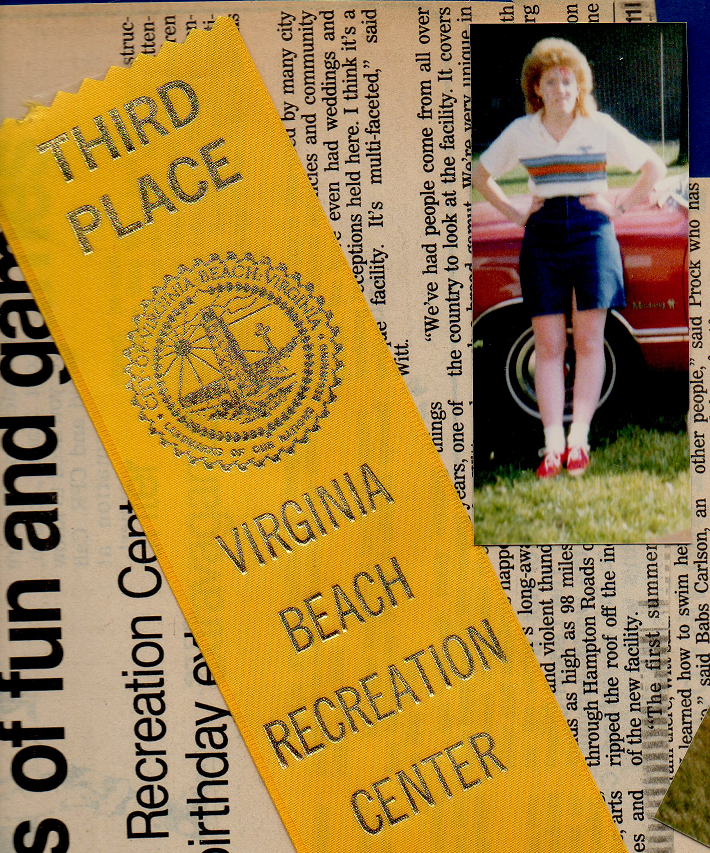
I also landed my first part-time job there in November of 1983. I was a tenth grader and the new part-time receptionist on Saturdays, Sundays, and Monday evenings. My first Saturday was during one of the Santa's Stocking craft shows. It was chaos, but I wouldn't have traded it for the world.

It was the best job ever. Don't tell Parks and Recreation. I would have done the job for free. Every teenaged boy came there to play soccer, basketball, and racquetball, and we had a skateboard ramp in the summers. I kept that part-time job through high school and college. I also added extra hours by working in the Teen Lounge and the ID Office.

I learned a lot of life and work lessons there. The staff was great. I honed my customer service skills because on weekends we were one of the only city offices open, and we got a lot of strange phone calls.

I also met a lot of characters and had adventures there. And that's always great fodder for a mystery writer!

This is me in my staff golf shirt at the 10th Anniversary Party.

This is me in my staff golf shirt at the 10th Anniversary Party.

Leading in a Changing World

I finished Ollie Malone's 101 Leadership Actions for Managing Change in the 21st Century recently.   His text is good if you're dealing with teamwork and change. Here are my key learnings.

1. Focus on the STAR model (Significant Tasks and Results).

2. Pay attention to what you resist. It will help you understand yours and others' resistance to change.

3. Ensure that your vision or plan includes others.

4. WIGS are Wildly Important Goals and WAGS are Wildly Aggressive Goals. You need WIGS and WAGS.

5. Watch what your industry is doing. Observe the trends and what's going on in your professional community.

6. Make sure that everyone on your team is cross-trained. Have lots of coverage for critical skills.

7. Breathe frequently. Make sure that you are not always going 100 mph.

8. Stress good communications.

9. Embrace technology.

Catch Phrase: A Lesson for Writers

My nieces introduced me to Catch Phrase this weekend. It's a timed game where you have to describe a word or phrase without using any part of it. So, not only do you have to know what the thing is; you've got to find a way to communicate it to your team in a way that they will understand. It's frustrating when your team doesn't get what you're describing.

It's the same with basic business communications. To pass on a idea to your readers, you need to:

  • Be clear and concise.
  • Use words that are understandable to your audience.
  • Look for common experiences.
  • Present the material in an organized fashion.
  • And proofread to make sure that your message is clear.

Best wishes with your writing. It's often harder to write in a plain, clear fashion. It often takes several revisions and some editing.

The Hamster Wheel

This week, guest blogger, Cortney Cain is writing about her work and writing experiences for Crazy for Words. Cortney is a recovering writer/editor who now teaches English for speakers of other languages. She and her husband, along with their tween and teen daughters, moved to the Shenandoah Valley recently after living near the coast for years.

A look at my Pinterest page is, admittedly, disappointing by most people’s standards. I’ve followed some pretty prolific posters, though, and *their* prowess might give you the impression that I’m upbeat and in touch. I’ve been neither of these for some time, but my family’s recent move from one corner of Virginia to the other has made me realize that it is not an area’s employment and entertainment offerings (or lack thereof) that are to blame for my current state of mind. It’s me.

I’ve cycled through boredom, self-doubt/depression, and then bootstrap-pull-uppance like a clumsy hamster for a while now. I picture myself as a little furry thing that runs really hard for a bit, trips comically and rides the momentum for a number of loop-de-loos, titters in annoyance as she stumbles off into the shavings, and then shakes the shavings off after she realizes how ridiculous it all is, only to look over and discover this shiny silver thing that could be a nice diversion.

Yep, that’d be me.

That cycle is something I noticed only recently when I found myself complaining about my job. (I should note that I’m between paid jobs at the moment.) It’s not that stay-at-home parenting is unfulfilling or tedious, though let’s admit it—we love that back-to-school commercial with “It’s the most wonderful time of the year” playing in the background because WE CAN RELATE. It’s the feeling that other women have this work/home thing worked out, and I’m the only one struggling with split personality disorder.

I had a job offer recently in something that I love: writing and editing. I went so far as to accept it and even get fingerprinted and background checked. If they’d asked, I would’ve peed in a cup. But then I got a call from the most persuasive HR person I’ve ever encountered anywhere—much less for a school system, which is notoriously “take it or leave it” in my experience—and voila! Yes, I found myself saying, I know teaching is the better fit for me right now because I owe it to my kids to be on their schedules. I called the writing/editing job offerer back and apologized for the late news, but I’d been given an offer I couldn’t refuse. How could I refuse being home with the kids on their breaks?

So now I’m in that resentment stage, where I’m dusting my shavings off, but I can already feel the allure of the silver wheel. Maybe, even with only a few weeks until new teacher orientation, there’s another job in writing and editing that will save me from the classroom. (If you have to ask why you need saving from the classroom, that’s a whole other series of blog entries. I don’t even really have horror stories, either, but all you have to do is turn on the TV to get some good ones.)

But then even if I could pull that off, there’d be the guilt. Sure, I’d feel guilty leaving a school to scramble to fill a job they’re already having difficulty filling. (I don’t flatter myself into thinking my resume is that impressive. My specialty is just in demand, and supply is low.) I’m talking about the Mom guilt. Ah, I remember the Mom guilt so well from my last writing job seven years ago, especially during the inevitable lulls. What are my kids up to right now? I should be home with them.

Doing what, though? Watching Spongebob’s latest exploits is my 10-year-old’s favorite pastime, and reading fan fiction about some androgynous lead singer of a band long disbanded is my teenager’s favorite. So now there’s another source of guilt: why am I not using this time to teach the girls about the world? Oh yeah. That usually takes money. Ironically, that’s a resource that, like Superman and Clark Kent, can’t be in the same room with another commodity: time. But isn’t Pinterest just chock-full of thrifty mom-as-inspiration and educator ideas? I hop on that wheel with all the gusto of a never-before-tripped rodent.

Alas, I am a hamster at heart. One of those pre-makeover ones from the cube-shaped car commercials. No, wait, I’d be one of their moms. The one covered in shavings.

 

The Generational Workforce

I recently completed an online course on "Managing Millennials." I am a member of Gen X. I was always one of the youngest in all of my work groups, but now, we're beginning to hire more of the Gen Y cohort. The work styles and expectations are different among the groups. And sometimes, there is friction.

I've seen a variety of names, and the years for each group vary slightly. Here are the generations that are sharing the workforce:

  • 1927 - 1945 - The Silent Generation, The Traditionalists
  • 1946-1964 - The Baby Boomers
  • 1965-1983 - Gen X
  • 1984-2002 - Gen Y, the Millennials
  • 2003- Present - Gen Z, Gen C (for Click), the Digital Generation

This is the first time in history when there have been so many different groups in the workplace at the same time. Gen Y outnumbers Gen X almost three to one.

Gen X was the most "unwanted" group. There was a rise during their early years in the use of birth control, abortion, day care, and women who chose not to have children. This is the generation with more working mothers and latch-key kids. All of this combined to make members of this cohort more self-reliant.

Gen Y, on the other hand, was the "most wanted" generation ever. They were born during the time of test tube babies, adoption, and surrogate mothers. Older parents were having children, and adoptions were on the rise. This generation has always been over-scheduled and busy with activities. Their parents have always been involved in every aspect of their life. They like constant feedback.

The next group that's coming along is Gen Z or Gen C (for click). This is the digital generation.

It was interesting to see the characteristics of each group and the history/cultural events that defined them. The work styles do vary among the groups.

This will give you a sense of the differences in Gen X and Gen Y.

The generations all come with their preferences and styles, and sometimes, it's a challenge to get all of the members to work together effectively.